

Did you know that the European veterinary services industry has grown to a massive €34.9 billion in 2026, yet you can still find world-class programs for veterinary science in europe with tuition fees as low as €8,200 per year? Many aspiring doctors feel held back by high costs at home and complex admission bureaucracy. You might worry that the path to a global degree is too risky or that your visa won't be approved. We understand these fears. Our team has helped thousands of students overcome these hurdles over the last twenty-three years.
This guide shows you exactly how to secure a seat at top-ranked, EAEVE-accredited universities. We provide a clear roadmap from choosing the right English-taught program to preparing for your visa interview. You'll gain expert insights into 2026 deadlines and cost-effective options in countries like Bulgaria and Slovakia. Transform your future with Ideal Study Abroad by following this proven path to a successful international career. Your journey starts here.
Key Takeaways
- Understand how a European Doctor of Veterinary Medicine (DVM) degree provides global recognition and aligns with international standards for your professional career.
- Identify the most affordable destinations for veterinary science in europe, focusing on premier hubs like Bulgaria and Romania that offer high-quality, English-taught programs.
- Learn the essential academic prerequisites and English language proficiency standards required to meet the 2026 application deadlines.
- Discover how expert handling of your visa documentation and professional pre-departure briefing can help you avoid common pitfalls and ensure a seamless relocation.
- Explore how leveraging twenty-three years of seasoned consultancy experience can help you match your profile to the right QS-ranked university for long-term success.
Why Study Veterinary Science in Europe in 2026?
Choosing a career in animal health is a noble pursuit. In Europe, this path leads to a Doctor of Veterinary Medicine (DVM) degree. This qualification isn't just a certificate; it's a comprehensive license to practice. According to this Veterinary Medicine Overview, the field covers everything from small animal care to public health. By 2026, European universities have expanded their English-taught offerings significantly. This shift makes high-tier education accessible to students from the UAE, India, and Nepal without the need to learn a new language first.
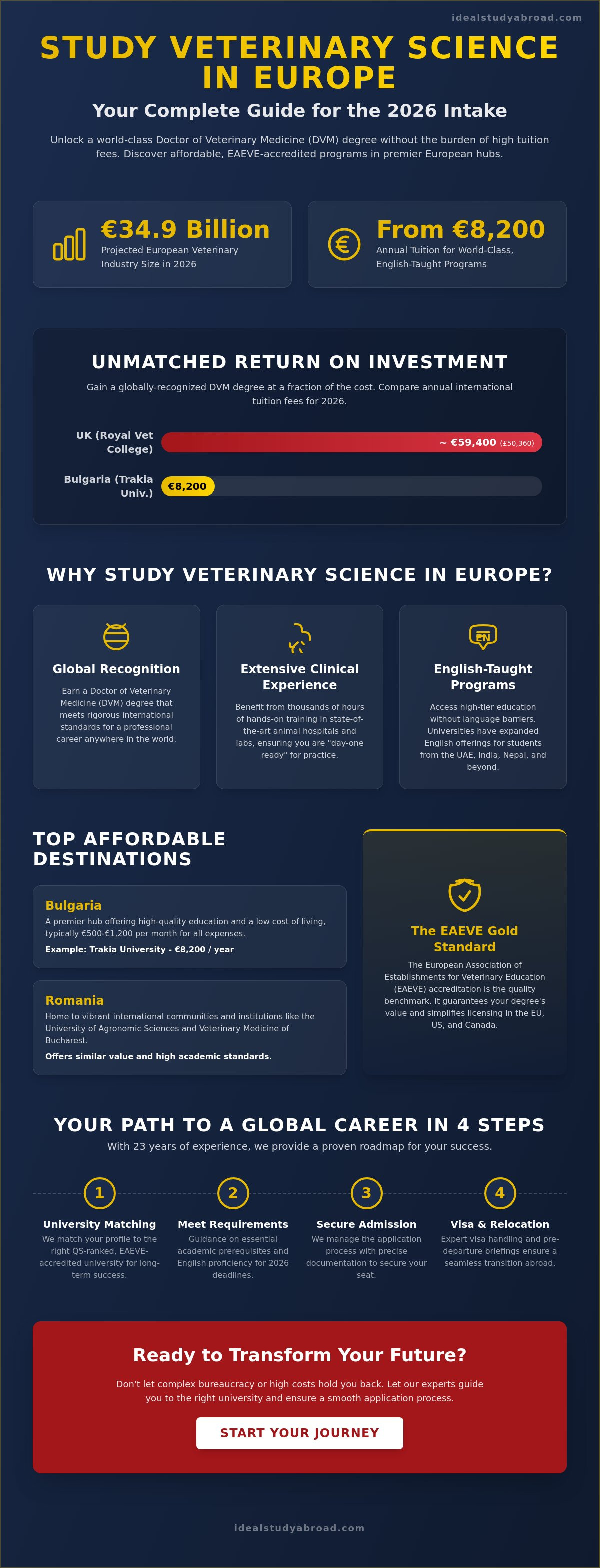
The return on investment for veterinary science in europe is currently unmatched. While the Royal Veterinary College in the UK charges international students £50,360 per year for 2026, institutions in Bulgaria and Slovakia offer similar quality for a fraction of that cost. For example, Trakia University in Bulgaria maintains a fee of €8,200 for the 2026-2027 academic year. You get the same rigorous training and clinical standards without the crushing debt often found in the US or UK systems. It's a strategic move for any student looking to maximize their future earnings.
The EAEVE Accreditation Advantage
The European Association of Establishments for Veterinary Education (EAEVE) serves as the gold standard for quality assurance. When you choose an EAEVE-accredited school, you're ensuring your degree meets strict international standards. This accreditation is pivotal. It allows for smoother license recognition across the EU and simplifies the process if you plan to practice in the US or Canada later. It's the first thing we check when matching students to universities.
Clinical Exposure and Modern Facilities
European veterinary education is deeply rooted in practical experience. Over a five to six year curriculum, you won't just sit in lecture halls. You'll spend thousands of hours in state-of-the-art animal hospitals and research laboratories. Students handle diverse cases, from equine surgery to exotic pet medicine, during their clinical rotations. This hands-on approach ensures you're "day-one ready" to join a practice upon graduation. It's this commitment to veterinary science in europe that produces world-class specialists.
At Ideal Study Abroad, we've spent twenty-three years helping students transform their future by identifying these high-value opportunities. We know the difference between a good program and a great one. Our expertise helps you bypass the confusion of choosing a destination. We focus on securing your place in a program that aligns with your long-term career goals. You aren't just applying to a school; you're launching a global career with a partner who understands the journey.
Top Destinations for Veterinary Science: Bulgaria, Romania, and Beyond
Finding the right location for your studies is a pivotal decision. While Western European countries often dominate headlines, the real value for veterinary science in europe lies in the East. Countries like Bulgaria and Romania have transformed into premier hubs for international medical education. They offer a unique blend of historical academic excellence and modern, English-taught curricula. You'll find that these regions provide a high standard of living at a fraction of the price found in London or Paris. Students typically budget between €500 and €1,200 per month for all expenses, including housing and food.
When you evaluate schools, don't just look at the brand name. It's essential to consult the official European Veterinary School Accreditation list. This ensures your degree carries the weight needed for global practice. While QS World Rankings offer a glimpse into research prestige, accreditation guarantees the quality of your clinical training. We've spent twenty-three years helping families decipher these rankings to find the perfect fit. If you're feeling overwhelmed by the choices, you can explore our university matching services to simplify your search.
Veterinary Medicine in Bulgaria and Romania
Bulgaria is home to Trakia University, where the English-taught program for veterinary science in europe costs €8,200 per year for the 2026-2027 intake. Romania offers similar value at the University of Agronomic Sciences and Veterinary Medicine of Bucharest. These institutions foster vibrant international communities. You'll study alongside peers from across the globe in cities that are safe, welcoming, and rich in culture. The admission process is straightforward, but it requires precise documentation to secure your seat.
Emerging Options in Georgia and Central Asia
Georgia and Uzbekistan are rapidly becoming rising stars for specialized veterinary tracks. Georgia, in particular, attracts students with its exceptionally low cost of living and high-quality medical infrastructure. These programs are designed to meet international standards. This ensures that your education is recognized by global veterinary boards. These destinations are ideal if you're looking for a budget-friendly path without compromising on the depth of your clinical exposure. They offer a transformative experience that prepares you for the realities of modern veterinary practice.
Admission Requirements and Application Timelines
Securing your place requires more than just good grades; it demands a strategic timeline. The journey toward a degree in veterinary science in europe begins a full year before you plan to depart. For the 2026 intake, you'll want to have your initial documents ready by late 2025 to stay ahead of rolling admission windows. For instance, the University of Veterinary Medicine Budapest accepts applications from January 1st until June 30th. Missing these windows can delay your career by an entire year, so punctuality is your best ally.
You'll need a comprehensive documentation package to impress admission boards. While each university has its own quirks, most require a standard set of credentials. The European Association of Establishments for Veterinary Education (EAEVE) sets the quality benchmarks that these programs must uphold, and their entry requirements reflect that rigor. You should prepare the following:
- Certified high school transcripts with strong marks in Biology and Chemistry.
- A valid passport with at least eighteen months of validity remaining.
- Letters of recommendation from science teachers or veterinary professionals.
- A personal statement highlighting your passion for animal welfare.
- Proof of English language proficiency through recognized testing systems.
Mastering the Entrance Exams
Most top-tier European schools require a written entrance examination. These tests typically focus on high school level Biology and Chemistry. Some institutions, like those in Bulgaria or Slovakia, may also include a brief section on general aptitude. Mastering these subjects is essential for anyone pursuing veterinary science in europe. After the written test, you'll often face a personal interview. This is your chance to show the faculty your communication skills and professional maturity. We provide tailored coaching to ensure you walk into these interviews with total confidence.
Language Proficiency for International Students
Since you're applying for English-taught programs, proving your language skills is a non-negotiable step. Most universities require a minimum IELTS score of 6.0 or 6.5. TOEFL and PTE scores are also widely accepted. You might be exempt from these tests if your previous education was conducted entirely in English, but it's always safer to check the specific university's policy. Our team helps you identify which test suits your strengths and handles the verification process with the university. This eliminates one of the most common causes of application delays.
Transform your future with Ideal Study Abroad by letting us handle the bureaucratic heavy lifting. We've spent twenty-three years refining this process, ensuring that your application is perfect before it reaches the dean's desk. You focus on your studies; we'll focus on your admission.
Navigating Visas and Pre-Departure Logistics
Securing admission to a program for veterinary science in europe is a major milestone, but the journey isn't over until your visa is stamped. The visa application phase is often the most stressful part of the process for students and their parents. Many qualified applicants face rejection because of minor documentation errors or a lack of preparation for the embassy interview. We've spent twenty-three years perfecting the art of visa processing to ensure your path remains clear and predictable. Getting the paperwork right the first time is the only way to avoid costly delays.
You must demonstrate that you have sufficient funds to cover both tuition and living costs for the duration of your stay. For the 2026-2027 academic year, living expenses in Europe vary, but students should generally budget between €500 and €1,200 per month for food, housing, and transport. Consulates require clear, verifiable bank statements or sponsorship letters that prove you can sustain yourself without working. If these documents aren't presented according to the specific embassy's standards, it can lead to an immediate denial of your application.
Professional Visa Interview Preparation
The embassy interview is your chance to prove you're a "Genuine Student." Visa officers look for clarity and consistency in your answers. They'll ask why you chose a specific university in Bulgaria or Romania over options in your home country. You must be able to articulate how studying veterinary science in europe fits into your long-term career goals. Our tailored coaching sessions build your confidence by simulating real interview scenarios. We help you refine your responses so they're professional and persuasive. You can book your visa interview preparation and consultancy today to start this critical phase with expert support.
Pre-Departure Guidance: Beyond the Classroom
Success abroad depends on how well you prepare before your flight ever leaves the ground. Our pre-departure briefings cover the logistical essentials that many students overlook in the excitement of moving. You'll need the following to ensure a smooth arrival:
- Valid health insurance that meets the host country's regulatory standards; for instance, students who are currently residents in Spain can consult Bsure Health Spain for expert guidance on travel coverage for 2026.
- A confirmed student accommodation agreement or temporary housing plan.
- Knowledge of local registration requirements for international residents.
- A clear understanding of the academic transition and European grading systems.
Leaving home is a transformative experience, but it comes with emotional challenges. We provide checklists for international travel and help you manage the transition to a new culture. Our goal is to make your relocation seamless so you can focus on your studies from day one. Transform your future with Ideal Study Abroad by letting our experienced mentors handle the complexities of your departure.
Transform Your Future with Ideal Study Abroad
Navigating the path to a global career is a life-changing experience. It requires a partner who has seen every possible scenario and knows how to overcome every hurdle. At Ideal Study Abroad, we bring twenty-three years of experience to your application. This seasoned wisdom ensures your journey into veterinary science in europe is smooth and successful. We don't just process papers; we build success stories. Our team understands the high stakes involved in international education, and we're here to instill confidence in both students and parents.
Personalized guidance is the cornerstone of our service. We don't believe in a one-size-fits-all approach. Instead, we provide a tailored consultancy that matches your unique academic profile and long-term career goals to the right university. Our expert handling of complex university and visa applications eliminates the uncertainty that often leads to rejection. We've spent over two decades refining our processes to simplify the daunting nature of overseas admissions. From your first consultation to the moment you walk across the stage at graduation, we remain your dedicated partner.
Tailored Medical and Healthcare Consultancy
Our expertise is deeply rooted in the healthcare sector. We specialize in super-specializations within Veterinary Science, MBBS, and Dentistry. This niche focus allows us to provide insights that generalist consultancies simply cannot offer. We have a proven track record of securing admissions in leading QS world-ranking institutions across Bulgaria, Romania, Georgia, and China. Whether you're looking for the affordable clinical excellence of Eastern Europe or the fully funded scholarship opportunities in China, we have the connections to make it happen. We ensure your degree meets all international standards for professional practice.
Start Your Journey Today
The roadmap to your veterinary career begins with a single, pivotal step. Start by booking your initial assessment with our expert consultants. We'll evaluate your transcripts, discuss your destination preferences, and create a manageable, sequential plan for your 2026 intake. This clear roadmap helps to demystify the application cycle and gives you a sense of agency over your own future. We handle the logistical realities so you can focus on the excitement of your transformative journey. Don't leave your education to chance; choose a mentor with a twenty-three-year history of proven results.
Transform your future with Ideal Study Abroad and take the first step toward a successful veterinary career. Our dual-location identity in Dubai and Kathmandu allows us to bridge the gap between your home and your international destination. Explore your options with a well-connected guide who is deeply committed to your success. Your global future is waiting, and we're ready to help you reach it.
Start Your Global Veterinary Career Today
Studying veterinary science in europe is more than an academic choice; it's a strategic investment in your future. You now have a clear roadmap for identifying EAEVE-accredited programs, meeting rigorous admission standards, and managing the logistics of moving abroad. Whether you're drawn to the advanced facilities in Slovakia or the cost-effective hubs in Bulgaria, the opportunity for a world-class education is within your reach. Success in 2026 requires early preparation and a deep understanding of the shifting international landscape.
With 23 years of expert educational consultancy, we specialize in medical and veterinary placements that change lives. Our team provides professional visa interview preparation and personalized guidance to ensure your application stands out. Don't let complex bureaucracy or high costs at home hold you back from your dreams. We've helped thousands of students navigate these high-stakes decisions with confidence and clarity. We're here to turn your aspirations into a successful reality.
Start Your Veterinary Journey in Europe with Ideal Study Abroad
Your path to becoming a doctor of veterinary medicine is waiting. It's time to take that first step toward a rewarding, international career in animal health. Let's begin this transformative journey together.
Frequently Asked Questions
Is a veterinary degree from Europe recognized in other countries?
European veterinary degrees are widely recognized internationally, provided the institution is EAEVE-accredited. This accreditation ensures your training meets the highest global standards. Graduates can typically sit for licensing exams in the US, UK, or Canada. We've seen hundreds of our students successfully transition into global practices over our twenty-three years of consultancy. It's a reliable path to a transformative career.
Can I study veterinary science in Europe in English?
You can absolutely study veterinary science in europe in English. Countries like Bulgaria, Romania, and Slovakia have developed robust English-taught tracks specifically for international students. These programs use the same curriculum as local-language tracks. This ensures you receive a high-quality education without the barrier of learning a new language before you begin your medical career. It's an accessible route for global students.
How much does it cost to study veterinary medicine in Europe?
Tuition fees for veterinary programs in Europe typically range from €8,000 to €13,000 per year. For example, programs in Bulgaria and Romania are among the most affordable options available for the 2026 intake. These costs are significantly lower than those in the UK or North America. We help you find a program that fits your budget while maintaining elite academic standards. It's a smart financial investment.
What are the entry requirements for international students?
Most universities require a high school certificate with strong marks in Biology and Chemistry. You'll also need to prove English proficiency via IELTS or TOEFL scores. Many institutions conduct their own entrance exams to assess your scientific knowledge and aptitude. Our team provides specialized coaching to help you master these assessments and secure your admission. We simplify the bureaucratic steps to ensure your success.
How long does it take to complete a veterinary degree in Europe?
A standard veterinary degree in Europe takes five and a half to six years to complete. This timeline includes a blend of theoretical study and extensive clinical rotations. The curriculum is designed to ensure you're "day-one ready" for professional practice. This comprehensive approach is what makes veterinary science in europe such a respected qualification worldwide. It's a rigorous but rewarding journey for any student.
Do I need a visa to study veterinary science in Europe?
International students from non-EU countries require a student visa to study in Europe. You must provide proof of university acceptance and financial stability to the embassy. The process can be complex, but our expert handling of visa documentation ensures you meet all regulatory requirements. We guide you through every step to prevent common pitfalls and rejections. Our goal is a seamless transition for you.
Can I work as a vet while studying in Europe?
You can't work as a veterinarian until you've graduated and obtained your professional license. However, most student visas allow you to work part-time, usually up to 20 hours per week, in non-medical roles. This can help cover living expenses while you study. We provide pre-departure briefings that explain the specific labor laws in your host country. It's a practical way to manage your budget.
Which European country is the easiest for veterinary admission?
Bulgaria and Romania are often considered the most accessible countries for veterinary admission due to their streamlined application processes. These countries offer a higher number of seats for international students in English-taught programs. While the academic standards remain high, the entry competition is more manageable than in Western Europe. We help you identify the best-fit university based on your unique academic profile.