
Starting in 2026, your high school GPA is no longer the primary gatekeeper for your dental career in Bulgaria. While many students assume that perfect grades are the only way into medical school, the Bulgarian Ministry of Education has shifted the focus toward entrance exam performance and document precision. It's understandable if you feel anxious about the confusing bureaucratic requirements or the prospect of sitting for mandatory exams in a foreign country. You want to focus on your future as a dentist, not get lost in a sea of paperwork and legalization hurdles.
This guide empowers you to master the complete admission requirements for dentistry in Bulgaria so you can apply with absolute confidence. We've simplified the complex 2026 regulations into a step-by-step checklist that covers everything from English proficiency scores to specific university deadlines. You'll gain a clear understanding of the new academic criteria, the latest entrance exam formats for schools like Sofia and Plovdiv, and the essential steps to ensure your documents are legally recognized. By the end of this article, you'll have a proven strategy to secure your seat in an English-taught Master of Dental Medicine program and begin your professional journey in Europe.
Key Takeaways
- Understand the 2026 shift in academic criteria where entrance exam performance now takes precedence over high school grade averages.
- Navigate the specific admission requirements for dentistry in bulgaria, including mandatory Biology and Chemistry prerequisites and English proficiency standards.
- Discover the structure of the three-pillar entrance examinations to prepare effectively for Biology, Chemistry, and English assessments.
- Master the chronological timeline for document collection and legalization to prevent common bureaucratic delays that can jeopardize your enrollment.
- Learn how tailored support and mock exam access provide the competitive edge you'll need to succeed in high-stakes dental school applications.
Why Study Dentistry in Bulgaria? The 2026 Academic Landscape
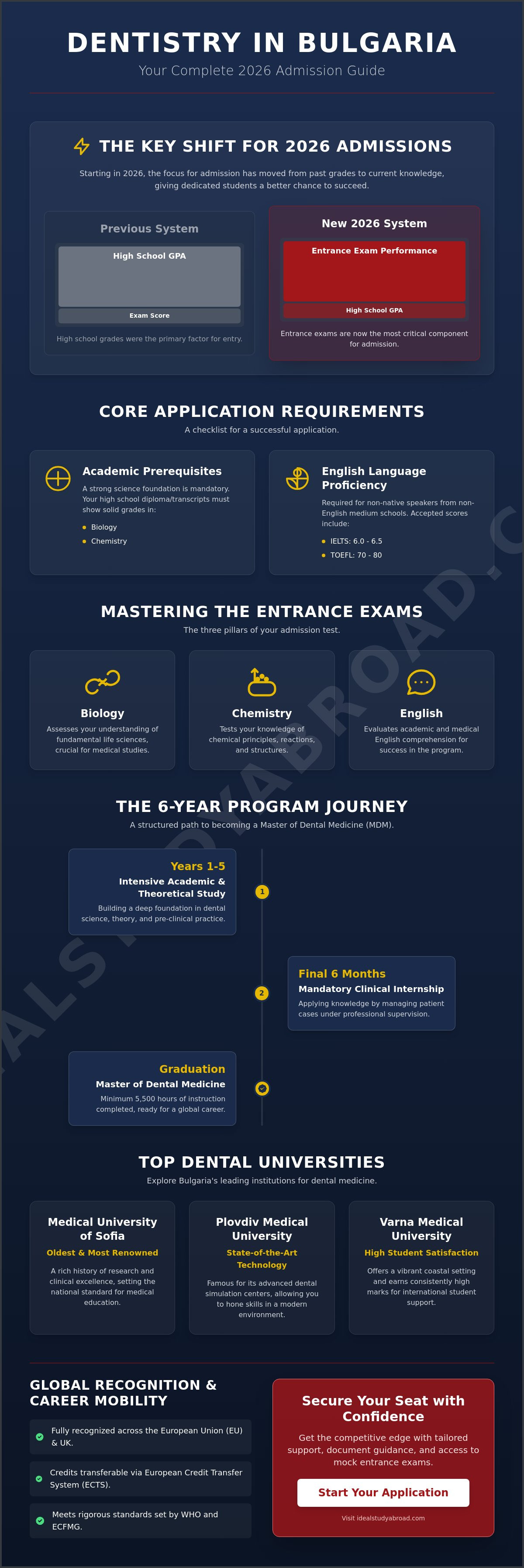
Bulgaria's reputation for dental excellence has grown significantly, making it a top-tier choice for international students in 2026. You'll find a curriculum that balances deep theoretical knowledge with early clinical exposure. The standard pathway is a six-year Master of Dental Medicine (MDM) program. This journey includes five years of intensive academic study followed by a final six-month clinical internship. Because these programs are taught entirely in English, you'll join a diverse, global cohort of future dental professionals. Understanding the admission requirements for dentistry in bulgaria is your first step toward joining this prestigious academic community.
Bulgarian universities have refined their English-language programs over decades to accommodate students from the UK, Ireland, Germany, and beyond. You won't just learn in a classroom; you'll work in modern clinics that mirror the environments you'll eventually practice in. This hands-on approach is why Bulgarian graduates are so highly sought after in the global job market. By mastering the admission requirements for dentistry in bulgaria, you're positioning yourself for a career with no geographic boundaries.
Accreditation and Career Mobility
Bulgarian medical universities follow the Bologna Process, ensuring your credits are fully transferable through the European Credit Transfer and Accumulation System (ECTS). This means your degree is recognized across the European Union, the United Kingdom, and many parts of Asia. The Master of Dental Medicine degree is a comprehensive professional qualification that requires students to complete at least 5,500 hours of clinical and theoretical instruction before graduation. This high standard ensures you meet the rigorous criteria set by the World Health Organization (WHO) and the Educational Commission for Foreign Medical Graduates (ECFMG) for 2026.
The Top Dental Universities for 2026
Choosing the right institution is vital for your long-term success. The Medical University of Sofia stands as the country's oldest and most renowned institution, offering a Faculty of Dental Medicine with a rich history of research and clinical excellence. If you prefer modern technology, Plovdiv Medical University is famous for its state-of-the-art dental simulation centers where you can hone your skills before treating patients. Varna Medical University offers a vibrant coastal setting and consistently earns high marks for international student satisfaction and support. Each of these schools has specific application windows, so early preparation is key to securing your seat.
Bulgarian dental schools don't just teach you how to fill a cavity; they prepare you for the legal and ethical complexities of modern medicine. The transition from the fifth year to the mandatory six-month internship is a pivotal moment in your evolution. During this phase, you'll manage your own patient cases under the supervision of seasoned professors. This practical experience is exactly why these degrees satisfy the stringent standards of the ECFMG and WHO. It's a rigorous path, but it's one that leads to a lifetime of professional stability and personal fulfillment.
Core Academic and Document Requirements for 2026
Securing your place in a Bulgarian dental school requires a meticulous approach to your academic portfolio. While the overall admission requirements for dentistry in bulgaria have become more streamlined for the 2026 intake, the Ministry of Education still maintains specific standards for science subjects. You'll need to demonstrate a solid foundation in Biology and Chemistry, ideally through your final secondary school transcripts. If your grades aren't perfect, don't lose hope. The current policy places significant weight on entrance exam performance, allowing dedicated students to prove their capability through the testing process even if their high school marks weren't top-tier.
English proficiency is another non-negotiable pillar of your application. If you aren't a native speaker or didn't graduate from an English-medium school, you'll generally need to provide a certificate like IELTS (6.0-6.5) or TOEFL (70-80). Some universities offer their own internal language diagnostic tests, but having a standardized score often speeds up the process. Proving your language skills early ensures you can handle the rigors of a medical curriculum without hesitation. Navigating these specifics can feel daunting, but you don't have to do it alone. If you're unsure about your eligibility, the team at Ideal Study Abroad can evaluate your transcripts and help you bridge any academic gaps.
Academic Eligibility Criteria
In previous years, a strict 62% average in Biology and Chemistry was the mandatory cutoff. For 2026, while the official rule has softened, this percentage remains a traditional benchmark for competitive ranking. If your science grades fall slightly below this threshold, you can often compensate by scoring exceptionally well on the university's entrance exam. It's essential to have both Biology and Chemistry listed on your final year certificate, as these subjects form the bedrock of your Master of Dental Medicine studies. You can find a detailed breakdown of these standards on the official Plovdiv Medical University requirements page, which serves as a reliable benchmark for most institutions.
The Essential Document Checklist
Precision is your best friend when gathering your application file. You'll need a valid passport with at least two years of remaining validity and several passport-sized photographs that meet the latest biometric standards. Your academic transcripts must be original copies, bearing the official seals and signatures of your school's registrar. For the 2026 intake, you must provide a notarized medical certificate that confirms your physical and mental fitness for dental practice, and this document must be issued within exactly one month of your application submission. Finally, you'll need an "Eligibility Letter" from your home country's education ministry or high school, stating that your diploma grants you the right to pursue higher education in dentistry.
Mastering the Bulgarian Dental Entrance Examinations
Don't believe the outdated myths that these exams are a mere formality. For the 2026 intake, the entrance test is the single most influential factor in your ranking. You must prepare for three distinct pillars: Biology, Chemistry, and English. Most universities, as outlined in the Medical University of Sofia international admission requirements, use a combination of multiple-choice questions and short, open-ended answers to test your depth of knowledge. This rigorous approach ensures that only the most dedicated students secure a seat in these competitive programs.
Your final score isn't just a pass or fail; it's a calculated ranking where your exam results are now the primary tool for selection. This shift in the admission requirements for dentistry in bulgaria is a significant advantage if your high school grades weren't perfect but you've since mastered the science prerequisites. Because the competition is fierce, self-study using general textbooks rarely suffices. You need to focus on the specific university syllabi and past papers to ensure your answers align with Bulgarian academic expectations. We've seen that students who engage in targeted coaching often outperform those who rely solely on their secondary school knowledge.
Biology and Chemistry Syllabus Breakdown
Expect a heavy focus on cell biology, human anatomy, and genetics for the 2026 Biology component. Chemistry papers will test your grasp of organic chemistry basics and complex chemical calculations. While the difficulty level is comparable to A-Levels or the IB, the question style is unique to Bulgarian medical institutions. You'll need to demonstrate precision in your definitions and speed in your calculations to finish within the allotted time. Mastering these specific topics is essential for meeting the admission requirements for dentistry in bulgaria and securing your enrollment.
Sitting the Exam: Online vs. In-Person
Many institutions, such as Plovdiv Medical University, have shifted toward proctored online examinations with multiple sessions held between April and August. This removes the need for international travel during the initial application phase. If you opt for an online exam, ensure your hardware meets the university's strict security protocols, including a high-definition webcam and a stable internet connection. Alternatively, Sofia Medical University typically requires an in-person sitting in early September. We recommend aiming for early sittings in April or May when possible. These early sessions provide a valuable buffer period to focus on document legalization once you receive your preliminary results.
The Application Timeline and Legalization Process
Applying for dental school in Bulgaria is a marathon that requires precise timing. Managing the admission requirements for dentistry in bulgaria requires strict adherence to a multi-phase calendar. If you miss a single deadline for document legalization, you might have to wait an entire year to reapply. We've broken the 2026 cycle into four manageable stages to help you maintain momentum and avoid common bureaucratic pitfalls.
- Phase 1 (January - March): Initial document collection. Gather your transcripts, medical certificates, and eligibility letters. Ensure every document is notarized by a local authority.
- Phase 2 (April - June): Legalization and Apostille. This is the most critical technical stage where your documents receive international recognition.
- Phase 3 (May - July): University submission and entrance exams. You'll submit your legalized file to your chosen medical university and sit for the required assessments.
- Phase 4 (August - September): Ministry of Education approval and D-Visa application. The Bulgarian Ministry issues your final acceptance certificate, which you'll need for your visa.
Understanding the Apostille and Legalisation
The Apostille is a specific stamp that validates your documents for use in Bulgaria under the Hague Convention. If your home country isn't a member of this convention, you'll face extra steps involving the Ministry of Foreign Affairs and the Bulgarian Embassy. This process can be incredibly slow; don't leave it until the summer months. Once your documents are stamped, they must be translated by Bulgarian-sworn translators. Standard translations from your local agency won't be accepted by the Ministry of Education. If you want to avoid the stress of last-minute filings, seek professional documentation support to ensure every stamp is in the right place.
Deadlines for the 2026 Intake
Early bird deadlines are your best friend. While some universities accept applications until late August for EU students, non-EU applicants should aim to finish their file by May. This early submission is vital because the "Ministry Approval" certificate can take up to six weeks to process. You cannot apply for your student visa or even enter the country for enrollment without this specific certificate in your hand. It serves as the final confirmation that you've met all admission requirements for dentistry in bulgaria. Once you have this, you can move toward visa interview preparation for your final step before departure. Applying early ensures you have a buffer for any unexpected document requests from the Bulgarian authorities.
Securing Your Seat with Ideal Study Abroad
Navigating the complex bureaucratic maze of international education is a high-stakes challenge that requires seasoned wisdom and meticulous attention to detail. You've already learned about the strict timelines and the rigorous entrance exams required for success. Now, you need a dedicated partner to ensure your application stands out in a competitive field. We specialize in transforming these daunting administrative hurdles into a seamless, manageable journey toward your professional goals. Meeting the admission requirements for dentistry in bulgaria is only the first step; the real challenge lies in the execution of your application strategy.
Our team provides a comprehensive suite of services designed to eliminate the risk of rejection. We focus on four critical areas to guarantee your success:
- Professional File Preparation: We conduct a multi-stage review of your documents to ensure zero errors in your Ministry of Education submission.
- Specialised Entrance Exam Coaching: Gain a competitive edge with exclusive access to our bank of past papers and realistic mock tests tailored for Sofia and Plovdiv.
- Expert Visa Guidance: Benefit from professional visa interview preparation that builds your confidence and ensures compliance with Bulgarian D-Visa regulations.
- End-to-End Relocation Support: We manage the logistics of your move, from securing university dormitory spots to assisting with local registration.
Beyond the Application: Pre-Departure and Arrival
Your evolution into a dental professional doesn't stop once you receive your acceptance letter. We provide comprehensive pre-departure briefings that cover everything from essential packing lists to cultural nuances you'll encounter in Bulgaria. Once you land, our on-ground team is there to meet you. We provide airport pick-up services and direct assistance with your first residence permit application. This level of support is part of the Ideal Study Abroad advantage. We bring decades of experience as a premier mbbs abroad consultancy to the dental field, ensuring you never feel alone in a foreign country.
Consult with Our Medical Education Experts
Every student's academic journey is unique, and your application should reflect that. We offer a personalised assessment of your high school transcripts to identify the best university fit for your specific academic profile and budget. We don't just provide a list of schools; we provide a roadmap to your future. Our mentors have encountered every possible application scenario and know exactly how to navigate the 2026 admission requirements for dentistry in bulgaria. Don't leave your medical career to chance. Take the first step toward your life-altering milestone and book your free dentistry admission consultation today to secure your future in Europe.
Your Path to a Global Dental Career Starts Here
Securing your seat in a Bulgarian dental school is a life-altering milestone that requires more than just academic ambition. The 2026 landscape prioritizes your performance in the three-pillar entrance exams and the absolute precision of your legalized documentation. Mastering the admission requirements for dentistry in bulgaria is a complex process, but it's one that leads to an internationally recognized degree and a future without borders. You don't have to navigate these high-stakes administrative hurdles alone.
With over 20 years of educational consultancy experience, we provide the seasoned wisdom you need to succeed. Our team offers expert guidance for top-ranked QS universities and specialized visa interview preparation to ensure your transition is seamless. We're committed to your long-term success and personal evolution as a medical professional. Don't let bureaucratic uncertainty hold you back from your dreams. Start your Bulgarian dentistry application today with Ideal Study Abroad and take the first step toward a rewarding career in Europe. Your journey is just beginning, and we're here to guide you every step of the way.
Frequently Asked Questions
Is there an age limit to study dentistry in Bulgaria?
There is no official upper age limit for international students applying to dental programs in Bulgaria. As long as you possess a valid high school diploma and meet the mandatory health criteria, you can pursue your Master of Dental Medicine at any stage of your career. This openness makes Bulgaria an attractive destination for mature students looking to transition into a high-stakes professional niche without the barriers found in other regions.
Can I transfer to a Bulgarian dental school from another university?
Yes, transfers are possible through the European Credit Transfer and Accumulation System (ECTS). Universities evaluate your previous transcripts to determine which clinical and theoretical credits are equivalent to the Bulgarian curriculum. It's essential to submit your request early, as the faculty must verify that your previous studies align with the 2026 academic standards before granting advanced standing in a higher year of study.
Do I need to speak Bulgarian to study dentistry there?
You don't need to speak Bulgarian to enroll in an English-taught program. All lectures, exams, and textbooks are in English for international cohorts. However, you'll take basic Bulgarian language classes during the first three years of the curriculum. This preparation is vital because you'll need to communicate effectively with local patients during your clinical rotations and your final six-month internship before graduation.
How much are the tuition fees for dentistry in Bulgaria for 2026?
For the 2026 intake, tuition fees generally range between €7,000 and €9,500 per year. Institutions like Sofia Medical University have a tiered structure, starting at €10,000 for the first year and slightly decreasing in later years. These fees remain highly accessible compared to Western European or North American dental schools, offering significant practical value and a high return on your long-term educational investment.
What happens if I fail the entrance exam?
If you don't pass the initial entrance exam, many universities offer a resit session, typically scheduled for early September. Some institutions, like Plovdiv Medical University, provide multiple testing sessions throughout the spring and summer months. Failing one session doesn't mean your journey is over; it's a chance to refine your preparation using mock tests and targeted coaching before the final 2026 intake deadline.
Is the Bulgarian dental degree recognised in the UK and USA?
Yes, Bulgarian dental degrees are internationally recognized and meet WHO and ECFMG standards. Because Bulgaria is an EU member, your degree is valid across Europe under the Bologna Process. For the UK, you can currently register with the General Dental Council (GDC). For the USA, you'll need to pass the National Board Dental Examination (NBDE) and potentially complete a supplemental program, depending on specific state regulations.
Are there scholarships available for international dental students in Bulgaria?
Direct financial scholarships for international dental students are limited, as most English-taught programs are self-funded. However, the combination of affordable tuition and low living costs acts as a practical financial advantage for most applicants. Some students may qualify for institutional merit-based awards after their first year of study, but you should plan your budget based on the standard annual fees for the six-year program.
When should I start my application for the 2026 intake?
You should begin gathering your documents in January or February 2026 to ensure you meet the admission requirements for dentistry in bulgaria without unnecessary stress. Starting early allows ample time for the Apostille process and professional translation by Bulgarian-sworn translators. Early applicants often secure their preferred entrance exam dates in April or May, providing a significant advantage and peace of mind well before the final competitive deadlines.