

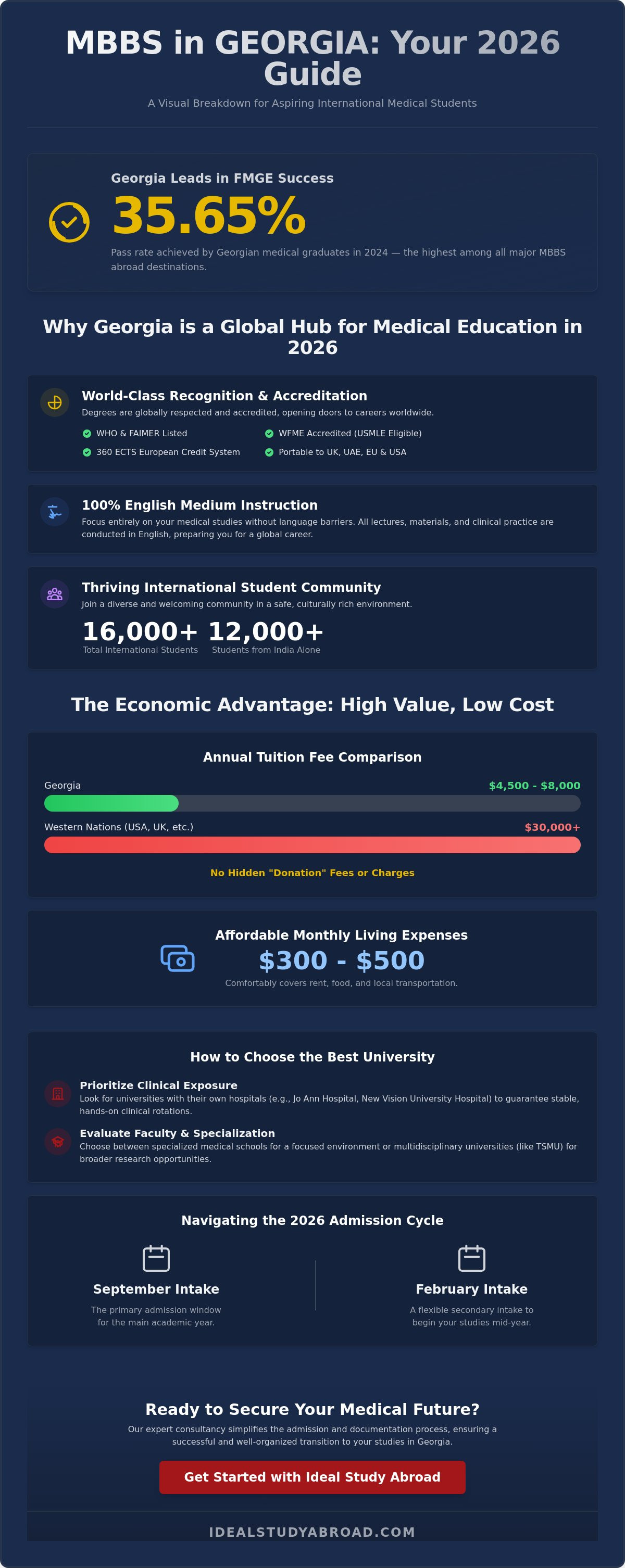
Did you know that in 2024, medical graduates from Georgia achieved a 35.65% pass rate on the FMGE? This is the highest among all major MBBS abroad destinations. It proves that finding the best medical universities in georgia for international students is about more than just finding a classroom; it is about securing a globally recognized future. You are likely feeling the weight of varying tuition costs and the new 2026 health insurance requirements. It is natural to seek certainty when your professional evolution is on the line.
We provide that clarity and help you transition into this life-altering milestone with seasoned wisdom. This guide will reveal the top-ranked Georgian medical institutions, compare 2026 tuition fees, and show you exactly how to secure your MBBS seat. We'll start by shortlisting the five most prestigious universities and then walk through the 2026 admission timeline. You will gain a complete understanding of living costs and visa steps, ensuring your journey to becoming a doctor is both successful and well-organized.
Key Takeaways
- Understand why Georgia's commitment to 100% English-medium instruction establishes it as a premier hub for global medical integration in 2026.
- Identify the best medical universities in georgia for international students by evaluating critical 2026 ranking factors like clinical exposure and faculty expertise.
- Compare the structural differences and tuition fee variations between public and private institutions to find the most financially accessible path for your medical degree.
- Master the 2026 admission cycle with a clear, step-by-step timeline for both the September and February intakes.
- Discover how professional consultancy and pre-departure briefings simplify the documentation process to ensure a successful transition to your international studies.
Why Georgia is a Global Hub for Medical Education in 2026
Georgia has transformed into a premier destination for medical aspirants seeking a balance of rigor and accessibility. By 2024, the nation hosted over 16,000 international students, with more than 12,000 arriving from India alone. This surge isn't accidental. It's the result of a deliberate alignment with international educational standards. The best medical universities in georgia for international students offer a 360 ECTS credit curriculum. This European Credit Transfer and Accumulation System ensures that your degree is equivalent to those earned across the European Higher Education Area. Because the medium of instruction is 100% English, you can focus entirely on clinical mastery without the distraction of a language barrier. Students enjoy a safe, culturally rich environment where the cost of living remains one of the lowest in the region.
Global Recognition and 2026 Accreditation Standards
Degrees from Georgia carry significant global weight. They are recognized by the World Health Organization (WHO) and listed in the World Directory of Medical Schools through FAIMER. As we move through 2026, WFME accreditation has become the critical gold standard for USMLE eligibility. This accreditation is now a mandatory requirement for students who wish to practice in the United States. While some students mistakenly search for Medical Schools in Georgia in the U.S. during their initial research, they quickly find that the country of Georgia offers a more streamlined and cost-effective path to the same international career. This commitment to high-stakes accreditation ensures your degree is portable to the UK, UAE, and throughout the European Union.
The Economic Advantage: High-Quality Education at Affordable Costs
Georgia offers a high-caliber education without the staggering debt often found in North America or Western Europe. Tuition fees typically range from $4,500 to $8,000 per year. This is a fraction of the cost in Western nations, where fees can easily exceed $30,000 annually. You won't face hidden "donation" fees or the opaque administrative charges common in other popular study-abroad hubs. Living expenses are equally favorable for the student budget. Most international students live comfortably on $300 to $500 monthly, which covers rent, food, and local transport. This financial accessibility allows you to invest your resources into your personal evolution and long-term professional success rather than just managing basic survival costs.
The combination of a world-class curriculum and a supportive economic environment makes Georgia a visionary choice. It's a place where your ambition to become a doctor is met with practical, high-value solutions. By choosing a Georgian medical degree in 2026, you're not just selecting a school; you're securing a life-altering milestone with a partner that values your future as much as you do.
Evaluating the Best Medical Universities in Georgia for International Students
Choosing where to spend the next six years of your life is a major personal evolution. The best medical universities in georgia for international students distinguish themselves through the quality of their clinical rotations and faculty expertise. When you evaluate these institutions, look beyond the glossy brochures. Focus on whether the university owns its hospital or relies on third-party sites. University-owned facilities, such as the Jo Ann Hospital or the New Vision University Hospital, provide a stable environment for hands-on learning. This direct access to patient care is vital for developing the diagnostic skills you'll need for global licensing exams.
For a broader perspective on institutional diversity and enrollment trends, you can consult the official list of Georgia medical schools. This resource helps clarify the landscape of accredited programs available to you. Understanding the distinction between specialized medical schools and general multidisciplinary universities is also crucial. Specialized schools often provide a more focused environment; general universities offer a broader academic community and more diverse research opportunities.
Tbilisi State Medical University (TSMU) and Ivane Javakhishvili (TSU)
Tbilisi State Medical University (TSMU) stands as the largest medical educator in the country. It remains a top choice when searching for the best medical universities in georgia for international students because of its historic reputation. With a tuition fee of $8,000 per year, it offers massive clinical exposure through an extensive network of affiliated clinics. Ivane Javakhishvili Tbilisi State University (TSU) provides a research-heavy curriculum that appeals to those aiming for academic medicine. Both are state-funded giants that prioritize a traditional, rigorous approach to medical science.
Top Private Universities: European University and New Vision University
European University and New Vision University represent the modern face of Georgian medical education. European University, priced at $5,500, offers exceptional training at its Jo Ann Hospital. This facility is a leader in pediatric cardiology, giving students specialized insights rarely found in general programs. New Vision University ($7,000) follows a curriculum specifically designed for USMLE success. These private institutions often maintain lower student-to-faculty ratios, ensuring you receive personalized guidance throughout your studies.
Regional Excellence: Batumi Shota Rustaveli State University
Batumi Shota Rustaveli State University offers a compelling alternative to the capital. At $5,000 per year, it provides a high-quality education in the vibrant Adjara region. Studying in Batumi allows you to experience a unique clinical environment while benefiting from a lower cost of living compared to Tbilisi. If you're unsure which city or institution fits your vision, our MBBS abroad consultancy team is ready to provide the seasoned wisdom you need to make an informed choice.
Public vs. Private Medical Universities: A 2026 Comparison
Deciding between a state-funded institution and a private academy is a pivotal moment in your educational journey. In Georgia, this choice often comes down to a balance between historical prestige and modern agility. Public universities like Tbilisi State Medical University are government-governed and carry decades of academic tradition. Conversely, private institutions are independent and often reinvest tuition directly into high-tech campus infrastructure. When looking for the best medical universities in georgia for international students, you'll find that both pathways lead to globally recognized degrees, yet the day-to-day experience differs significantly. Tuition reflects this structural split; state giants often maintain higher fees around $8,000, while private options can start as low as $4,500.
Evaluating these options requires a clear understanding of your own learning style. Do you thrive in a large, traditional environment, or do you prefer a smaller, more specialized setting? Our MBBS Abroad Consultancy team often helps students navigate this exact crossroads by matching their career goals with the right institutional type. While global benchmarks like the U.S. News Best Medical Schools rankings provide a framework for research-heavy institutions in the West, the Georgian context rewards those who look closely at clinical rotation quality and student support services.
Curriculum Flexibility and Modern Infrastructure
Private universities in Georgia are known for their ability to pivot quickly. They often adopt international curricula, such as USMLE-integrated programs, faster than their state-run counterparts. You'll frequently find cutting-edge simulation labs and advanced diagnostic tools in private clinics that mirror the latest medical trends. While state universities maintain a rigorous, encyclopedic approach to medical science, private schools like New Vision or European University focus on practical, high-stakes scenarios. This structural simplicity helps to demystify complex medical concepts through early hands-on exposure.
Clinical Exposure and Patient Interaction
The clinical experience is where the best medical universities in georgia for international students truly shine. State hospitals are massive hubs with a high volume of patients, offering a vast array of cases. This high patient flow is excellent for seeing rare conditions, though these environments can sometimes feel crowded. Private clinics, while smaller, offer more personalized patient interaction and specialized care settings. Most Georgian universities now integrate mandatory Georgian language courses into the first three years. This ensures that by the time you reach your clinical rotations, you can communicate effectively with patients, turning every ward round into a meaningful learning opportunity.
Navigating the 2026 Admission Process and Requirements
Success in securing a seat at the best medical universities in georgia for international students depends on a disciplined, well-timed strategy. For the 2026 intake, your research and planning should ideally begin in January or February. By July, you must have your admission confirmation and initial fee payments finalized to stay on track. The Ministry of Education and Science of Georgia, specifically the National Center for Educational Quality Enhancement, oversees the recognition of foreign documents. This process is the bridge between your past academic achievements and your future as a physician. It's a high-stakes administrative phase where seasoned wisdom helps avoid common filing errors that could stall your progress.
Eligibility Criteria for International Applicants
Most Georgian medical institutions look for a solid foundation in the sciences. You should aim for a minimum of 50% in Biology, Chemistry, and Physics on your high school transcripts. While some students worry about standardized tests, the best medical universities in georgia for international students often prioritize their own internal assessment. Many universities have moved toward mandatory online interviews via platforms like Zoom to evaluate your English proficiency and motivation. This ensures you're ready for the 100% English-medium curriculum. You must generally be at least 17 years old by the end of 2026. Transfer students can also apply, provided they submit a detailed syllabus for a comprehensive credit evaluation.
The Visa and Residency Permit Journey
Once your university enrollment is secured, the focus shifts to the D3 category student visa. This application typically happens in August. You'll need to gather specific documents, including your university invitation letter and proof of sufficient funds. A critical update for 2026 is the mandatory health insurance requirement, which must provide at least 30,000 GEL in coverage. The government visa application fee is approximately 80 GEL, or about $29 USD. After you land in Georgia, you'll need to transition your student visa into a temporary residence permit. This permit is your official legal standing for the duration of your MBBS program. Navigating this bureaucratic transition is easier when you've prepared for the high-pressure environment of the consulate. Read our expert guide on Visa Interview Preparation to ensure you're ready for every question.
The journey from applicant to medical student is a significant personal evolution. It requires a partner who understands the logistical realities of international transitions. If you're ready to begin your application, our undergraduate admission assistance team can simplify these sequential steps and guide you toward a successful enrollment.
Expert Placement: How Ideal Study Abroad Secures Your Medical Future
Embarking on a journey to the best medical universities in georgia for international students is a significant personal evolution. It requires more than just a standard application; it demands a dedicated partner with a voice of seasoned wisdom. Ideal Study Abroad acts as your Experienced Global Mentor, bringing over two decades of industry tenure to your specific case. We specialize in high-stakes professional niches, ensuring your transition into the medical world is handled with the seriousness it deserves. While some students also explore options to Study Medicine in Romania, our deep-rooted connections in Georgia provide a unique advantage for those focused on the 2026 intake.
Personalized University Matching and Application Management
We don't believe in a one size fits all approach. Our process begins with matching your unique academic profile to the Georgian university that best aligns with your career goals. We provide end-to-end management of the EQE process through the National Center for Educational Quality Enhancement. This administrative stage is often where students feel the most confusion, but our team simplifies these complex bureaucratic hurdles into manageable, sequential steps. By performing meticulous document vetting before submission, we significantly reduce the risk of admission rejection, giving you the confidence to focus on your future studies.
Beyond Admission: Pre-Departure and On-Ground Support
Our commitment to your success extends far beyond the receipt of an invitation letter. We understand that moving to a new country is a life-altering milestone that involves practical logistical challenges. To prepare you, we conduct specialized pre-departure briefings that cover everything from the new 2026 health insurance requirements to cultural nuances in Tbilisi and Batumi. Once you arrive, our on-ground support helps you find suitable student accommodation and navigate local registration with the authorities. We remain a steady, reliable resource throughout your six year medical journey, ensuring you stay focused on becoming a world class physician.
Choosing the right path in 2026 is about more than just tuition fees; it's about securing a degree with global portability. Our MBBS abroad consultancy service is designed to instill confidence and provide the momentum you need to reach your professional goals. We invite you to partner with a team that views your success as our own primary mission. Let us help you turn your ambition into a practical, successful reality in the heart of Georgia.
Secure Your Medical Career in Georgia Today
Transitioning into a global medical career is a significant personal evolution that requires both vision and practical planning. You've seen that the best medical universities in georgia for international students offer a rare combination of 100% English-medium instruction and high-stakes clinical exposure. Whether you choose the historical prestige of a state giant or the modern agility of a private institution, your success depends on aligning your academic profile with the right 2026 accreditation standards and clinical facilities.
Navigating these complex bureaucratic processes shouldn't feel daunting. With over 20 years of educational consultancy expertise, our specialized medical school placement team provides the seasoned wisdom you need to secure your seat. We offer comprehensive visa and pre-departure support to ensure every step of your journey is manageable and successful. Start your medical journey with Ideal Study Abroad today and take the first step toward your life-altering milestone. Your future as a world-class physician is within reach, and we're ready to guide you there.
Frequently Asked Questions
Is the MBBS degree from Georgia recognized globally in 2026?
Yes, medical degrees from Georgia are recognized by major global bodies including the World Health Organization (WHO) and the World Federation for Medical Education (WFME). This high-stakes accreditation ensures that your degree is portable for licensing exams like the USMLE in the United States or the PLAB in the United Kingdom. It's a critical factor that supports your personal evolution into a globally practicing physician.
What is the total cost of studying medicine in Georgia for international students?
The total cost includes annual tuition fees ranging from $4,500 to $8,000 depending on the institution. You'll also need to budget for monthly living expenses between $300 and $500 to cover housing, food, and transport. The best medical universities in georgia for international students also require a health insurance policy with 30,000 GEL coverage as of January 2026.
Do I need to clear IELTS or TOEFL to study medicine in Georgia?
You aren't strictly required to provide IELTS or TOEFL scores for most Georgian medical programs. Instead, universities typically conduct their own internal English proficiency interviews or exams via Zoom during the admission process. This structural simplicity helps to demystify the transition for students from diverse linguistic backgrounds while ensuring they're ready for an English-medium curriculum.
Can I practice medicine in my home country after graduating from Georgia?
You can practice in your home country as long as you fulfill the specific registration requirements of your local medical council. For instance, Indian students must have qualified for NEET-UG and must pass the FMGE or NExT exam after graduation. Georgia’s impressive 35.65% FMGE pass rate in 2024 demonstrates that its curriculum effectively prepares students for these rigorous professional milestones.
What is the duration of the MD/MBBS program in Georgia?
The medical program in Georgia lasts for six years and consists of 360 ECTS credits. This timeline is designed to follow the European credit system, divided into three years of fundamental pre-clinical studies and three years of intensive clinical rotations. This steady, logical flow ensures you gain both the theoretical knowledge and the hands-on experience required for modern medical practice.
Are there any scholarships available for international medical students in Georgia?
Direct government scholarships for international students are limited in the medical field. However, some private institutions offer merit-based tuition discounts to students who maintain exceptional academic records. You should check with each university’s admissions office for current financial assistance opportunities that could support your long-term success without the need for high-interest loans.
What is the medium of instruction for international students in Georgian medical schools?
The medium of instruction is 100% English for all international medical programs in Georgia. This allows you to focus entirely on your medical training without the burden of learning a new language for your coursework. While the best medical universities in georgia for international students teach in English, you'll also receive basic Georgian language lessons to help you communicate with patients during clinical rotations.
Can I transfer from another medical university to a Georgian university in 2026?
You can transfer to a Georgian university provided you undergo a formal credit evaluation process. The National Center for Educational Quality Enhancement (EQE) must review your previous transcripts and syllabus to determine how many credits are transferable. This process ensures your prior education aligns with Georgian standards, allowing you to continue your medical journey without starting from the beginning.