

What if the biggest hurdle to your medical career in 2026 isn't the chemistry exam, but a single missing point on a language certificate? As you look toward your future, understanding the specific english requirements for medical universities in europe is the vital first step to ensuring your application doesn't end up in the rejection pile. You've likely spent years mastering biology and physics, yet the thought of managing dozens of different country-specific language standards feels overwhelming. It's natural to feel stressed about whether an IELTS 6.5 is enough for Bulgaria or if you need a TOEFL 100 for a top-tier program in Poland.
We understand that this administrative maze can feel like a distraction from your true goal of becoming a doctor. This guide simplifies that journey by providing a clear, actionable roadmap for the 2026 intake. You'll master the exact proficiency standards, minimum test scores, and the specific exemptions that could save you hundreds of dollars in testing fees. We'll preview the universities offering their own internal assessments and show you how to use your existing qualifications to satisfy visa requirements. By the end of this article, you'll have a complete checklist to secure your seat in a European medical school with absolute confidence.
Key Takeaways
- Navigate the 2026 CEFR standards to ensure your current language level meets the rigorous academic demands of European medical education.
- Benchmark your skills against the latest english requirements for medical universities in europe to target the precise IELTS, TOEFL, or PTE scores required for admission.
- Identify specific pathways to waive standardized testing requirements through your previous academic background or International Baccalaureate results.
- Prepare for the increasing shift toward internal university-led English assessments that prioritize medical terminology over general conversational skills.
- Streamline your application by learning how to align your language documentation with the specific administrative expectations of top-tier medical faculties.
Why English Proficiency is Non-Negotiable for Medical Studies in Europe
Studying medicine in a non-English speaking country doesn't mean you'll be learning in a foreign tongue. Across the continent, English-medium programs have become the gold standard for international students seeking high-quality education at a fraction of the cost found in the UK or US. These programs are designed specifically for global candidates; every lecture, textbook, and examination is conducted in English. However, this accessibility comes with a rigorous gatekeeping mechanism. Understanding the specific english requirements for medical universities in europe is essential because these standards protect both your academic progress and future patient safety. If you can't grasp the nuances of pathophysiology or pharmacology in English, the risk of clinical error becomes unacceptably high. When exploring the vast List of European Medical Schools, you'll find that while locations vary, the demand for linguistic precision remains constant.
In 2026, universities don't just guess your ability. They rely on the Common European Framework of Reference for Languages (CEFR) to verify that you can handle the mental load of a medical degree. Medicine is a language of its own. It requires more than just conversational fluency. You must be able to synthesize complex data, write detailed medical reports, and engage in high-stakes discussions with peers. Without a solid linguistic foundation, even the most brilliant scientific mind will struggle to pass the first year of an MBBS or MD program.
The Shift Toward Standardized CEFR Levels
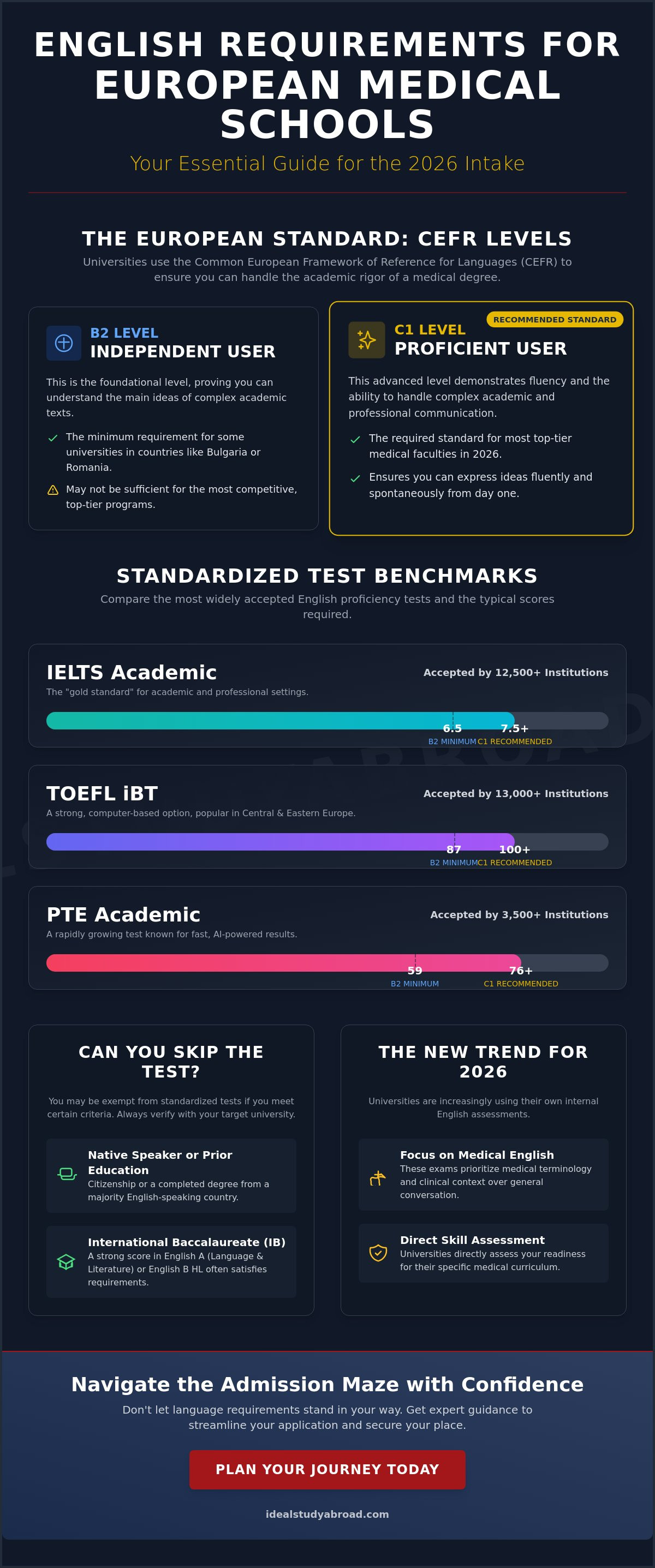
Most European medical faculties have standardized their entry criteria around the B2 and C1 levels. A B2 level, often called an "Independent User," suggests you can understand the main ideas of complex text on both concrete and abstract topics. While some schools in Bulgaria or Romania may accept a strong B2, many top-tier institutions now insist on C1. This "Proficient User" status ensures you can express ideas fluently and spontaneously without much obvious searching for expressions. This shift toward C1 reflects the increasing competitiveness of 2026 admissions and the need for students to hit the ground running from day one.
Language Requirements for Clinical vs. Pre-clinical Years
Your journey begins with the pre-clinical years, where English is your primary tool for mastering anatomy, biochemistry, and physiology. During this phase, your proficiency supports your ability to absorb massive amounts of scientific theory. As you transition into clinical years, the focus shifts. While your formal education remains in English, you'll eventually need basic local language skills to speak with patients at the bedside. However, the long-term value of your English-taught degree cannot be overstated. It serves as the primary evidence of your language skills when you eventually apply for international licensing, such as through the GMC in the UK or the USMLE in the United States. Your English proficiency isn't just an entry requirement; it's a lifelong professional asset.
Standardized English Tests: IELTS, TOEFL, and PTE Score Benchmarks
Selecting the right proficiency test is a strategic decision that shapes your entire application timeline. While many exams exist, three main players dominate the landscape for 2026. The International English Language Testing System (IELTS) Academic remains the gold standard, accepted by over 12,500 institutions worldwide. It's favored for its balance of academic rigor and practical communication. Alternatively, the TOEFL iBT is a strong contender, particularly for students targeting universities in Central and Eastern Europe, with over 13,000 institutions recognizing its computer-based format. Before committing to a test date, always verify your chosen institution in the World Directory of Medical Schools to ensure your degree will have global standing.
A significant trend for the 2026 intake is the rapid adoption of PTE Academic. More than 3,500 institutions now accept this test because it offers faster results and a fully automated scoring system. If you're looking for a lifelong qualification, Cambridge English C1 Advanced or C2 Proficiency certificates provide permanent proof of your abilities, though they require a deeper level of preparation. Matching your current skills to the english requirements for medical universities in europe ensures you don't waste time on exams that don't align with your target school's preferences.
Country-Specific Score Requirements for 2026
Different regions set their own benchmarks based on the competitiveness of their programs. In Georgia and Uzbekistan, universities typically look for an IELTS score of 5.5 to 6.0. Moving toward the Balkans, medical faculties in Romania and Bulgaria have standardized their requirements between IELTS 6.0 and 6.5. If your heart is set on Poland or the Czech Republic, prepare for higher standards. These countries often demand a minimum of IELTS 7.0 or a C1 level certificate to ensure students can handle the intensive curriculum. If you're feeling unsure about which path fits your background, our MBBS abroad consultancy can help you map out a personalized admission strategy.
Score Validity and Retake Strategies
Timing is everything. Most test results are only valid for two years. If you took your exam early in high school, check the expiration date to avoid a last-minute scramble. Sit for your exam at least four to six months before application deadlines to allow for potential retakes. One helpful feature in 2026 is the IELTS 'One Skill Retake' option. This allows you to improve a single component, like Writing or Speaking, without sitting the entire three-hour exam again. Many European universities now accept these updated scores, making it easier than ever to meet the necessary benchmarks without starting from scratch. Plan your testing schedule around your academic strengths and give yourself the grace of a backup plan.
English Language Exemptions: Do You Need an Official Certificate?
Not every applicant needs to spend hundreds of dollars on a standardized test. If your previous education was conducted entirely in English, you might already possess the necessary credentials to bypass the exam phase. This flexibility is part of the broader effort by the European Higher Education Area (EHEA) to create a more integrated and accessible academic landscape across the continent. By recognizing existing qualifications, universities make it easier for qualified students to focus on their medical training rather than bureaucratic hurdles.
Students from majority English-speaking nations, including the UK, USA, Canada, and Australia, typically receive automatic exemptions. However, the path is also open for those from international backgrounds. If you've completed the International Baccalaureate (IB) Diploma, your English A or English B scores can often serve as definitive proof. Similarly, strong performances in A-Levels or GCSEs frequently allow students to satisfy the english requirements for medical universities in europe without additional testing.
The MOI Certificate Strategy
A Medium of Instruction (MOI) certificate is a formal declaration from your high school confirming that English was the primary language used for all teaching and examinations. For students graduating from English-medium schools in regions like the UAE, this document is a powerful tool. To ensure the document is accepted, it must include:
- Official school letterhead and valid contact details.
- A clear statement that all subjects (excluding foreign languages) were taught in English.
- The specific dates of your enrollment.
- An official seal and the signature of the principal or registrar.
Universities in Georgia and Romania are notably flexible with this approach, often accepting a well-documented MOI in place of an IELTS certificate. It's a practical way to prove you're ready for the rigors of medical school without the stress of another standardized test.
Proving Proficiency Through High School Grades
Many admissions committees will look directly at your high school transcripts to gauge your language readiness. You'll typically need to demonstrate a consistent track record, often with grades reaching 70% to 80% in English-related subjects over your final two years of study. When you submit your application, present these transcripts clearly and highlight the relevant modules to help the admissions officers. While this strategy is effective for meeting the english requirements for medical universities in europe, it isn't foolproof. Some competitive faculties may still request a standardized test if your school's curriculum isn't internationally recognized. Relying solely on grades carries a small risk, so it's wise to keep an IELTS booking in mind as a backup plan just in case the university's policy shifts during the 2026 cycle.
Beyond the Basics: University-Specific Entrance Exams and Medical English
For many applicants, the standard IELTS or TOEFL path isn't the only way to satisfy the english requirements for medical universities in europe. In 2026, we're seeing a significant increase in universities that prefer their own internal assessments. These exams are often integrated directly into the science entrance tests for Biology and Chemistry. For instance, if you're applying to Jagiellonian University in Poland for the May 23, 2026 entrance exam, your ability to comprehend complex scientific questions in English is evaluated simultaneously with your medical knowledge. This approach ensures you don't just know the language, but you can actually apply it in a high-pressure clinical context.
Medical English differs sharply from the conversational English you use with friends. It's a specialized vocabulary focused on precision and clinical accuracy. While a general test might ask you to describe a hobby, a medical entrance exam will require you to understand the terminology of the cardiovascular system or the nuances of cellular respiration. Professors aren't looking for poetic flair; they want to see that you can communicate clinical facts without ambiguity. This focus on "purpose-built" language is why schools like Palacky University in the Czech Republic, which has its latest exam scheduled for July 10, 2026, place such high weight on their own subject-specific testing.
Preparing for the Internal English Assessment
These tests usually follow a predictable format: multiple choice grammar, reading comprehension based on scientific texts, and short essays. You won't find questions about your favorite holiday here. Instead, you'll practice with medical-themed vocabulary and summarize texts on genetics or physiology. The main advantage is practical value. You avoid the high fees of standardized tests, which can range from $215 to $345 USD, and you often receive your results immediately. This streamlined process allows you to focus your energy on the science modules that matter most.
The Oral Interview: Demonstrating Communication Skills
Oral interviews via Zoom or Skype have become a standard part of the selection process for many 2026 programs. Universities prioritize your ability to explain concepts clearly because effective patient communication is the foundation of modern medicine. You can expect questions regarding your motivation for choosing a medical career and how you plan to handle the academic load. Focus on your pronunciation and maintain a logical flow in your responses to demonstrate that you can think clearly under pressure. If the thought of a live interview feels daunting, our visa interview preparation team can help you build the confidence needed to impress the admissions board.
Navigating the Admission Maze: Expert Support for Your Medical Journey
The path to becoming a doctor in Europe involves more than just passing a test. It requires a meticulous approach to documentation and a deep understanding of institutional preferences. Ideal Study Abroad leverages decades of industry experience to streamline this process for you. We ensure that your language certificates and academic transcripts align perfectly with the 2026 standards of your chosen faculty. By verifying every document before submission, we eliminate the risk of technical rejections that often plague solo applicants. Meeting the english requirements for medical universities in europe is the first milestone in a journey that we manage with seasoned precision.
We believe that administrative hurdles shouldn't stand in the way of a brilliant medical career. Our role is to act as your experienced global mentor, converting complex bureaucratic requirements into a manageable, sequential plan. We don't just help you apply; we help you succeed by positioning your application to meet the specific expectations of European admissions committees.
Strategic University Matching
Not every student needs a perfect IELTS score to secure a world-class education. We specialize in matching your current proficiency level with the right institution to ensure a successful outcome. If your results are in the IELTS 5.5 to 6.0 range, we guide you toward reputable programs in Georgia or Uzbekistan where these scores are standard. For high-achievers with scores of 6.5 or above, we focus on securing seats in top-tier medical faculties in Romania, Bulgaria, or Poland. This customized selection process reduces the stress of multiple applications and ensures you apply only where you're most likely to be accepted.
Comprehensive Support from Application to Visa
Your language proof serves a dual purpose. While it secures your university seat, it's also a critical component of your visa application. For UAE residents, meeting specific embassy requirements is essential to avoid delays or rejections. A strong certificate is only half the battle. You must also demonstrate that proficiency during your interactions with visa officers. This is why we provide specialized visa interview preparation to ensure you communicate your goals with clarity and confidence.
Our support continues even after you receive your acceptance letter. We conduct pre-departure language briefings to help you transition from academic English to the practical communication needed for your first weeks abroad. This prepares you for the high-stakes environment of medical lectures and clinical rotations. From initial university selection to your final departure, we stand as your dedicated partner in this life-altering transition. Consult with our MBBS abroad experts today to begin your journey into the European medical community.
Take the First Step Toward Your Global Medical Career
Securing your future in medicine depends on your ability to meet the specific english requirements for medical universities in europe with precision and confidence. You've learned that whether you're submitting an IELTS score, leveraging an IB diploma exemption, or preparing for a university-specific oral interview, your linguistic preparation is just as critical as your scientific knowledge. Success in 2026 requires a strategic match between your current skills and the right institution's standards. This journey is more than just a logistical step; it's a significant personal evolution.
With over 20 years of expertise in international medical placements, we provide the specialized guidance you need for top programs in Georgia, Romania, and Bulgaria. Our comprehensive support includes everything from initial document verification to specialized visa interview preparation, ensuring you're ready for every administrative hurdle. Don't let confusing standards delay your progress toward becoming a doctor. Secure Your Medical School Seat in Europe for 2026 and begin this life-altering milestone with a partner you can trust. Your medical career is within reach, and we're here to ensure you arrive at your destination with absolute certainty.
Frequently Asked Questions
Can I study medicine in Europe if my IELTS score is only 5.5?
Yes, you can certainly secure an MBBS seat with an IELTS score of 5.5, particularly in countries like Georgia and Uzbekistan. While many universities in Poland or the Czech Republic demand a 7.0, these regions offer more flexible entry paths for international students. We specialize in identifying reputable programs that prioritize your scientific potential over a single test score, ensuring you don't lose a year of study.
Do all European medical schools require an English proficiency test?
No, not all institutions insist on a standardized certificate like IELTS or TOEFL. Many universities offer their own internal English assessments or allow you to prove your skills through high school grades in English-medium curricula. These internal tests are often integrated into the science entrance exam, allowing you to demonstrate your clinical vocabulary and academic readiness in a single sitting.
Is the PTE Academic test widely accepted by medical universities in Europe?
Yes, the PTE Academic is now accepted by over 3,500 institutions and is rapidly becoming a favorite for the 2026 intake. Its fast results and automated scoring make it an excellent alternative for students who need to meet english requirements for medical universities in europe on a tight deadline. It's particularly well-regarded in Central European countries where computer-based testing is the standard.
What happens if I fail the university's internal English entrance exam?
If you don't pass the internal assessment, you usually won't be able to proceed with that specific application for the current intake. However, this isn't the end of your journey. Some faculties offer intensive English preparatory semesters to help you reach the required level. Alternatively, we can help you pivot your application to a university with different criteria to keep your career goals on track.
I studied in an English-medium school in Dubai; do I still need IELTS for Romania?
You can often bypass the IELTS requirement for Romanian medical faculties by providing a valid Medium of Instruction (MOI) certificate. This document must be an official letter from your school confirming that your entire secondary education was conducted in English. It's a highly effective strategy for students from the UAE to save time and reduce the financial burden of redundant testing.
Which European country has the easiest English requirements for medical school?
Georgia and Uzbekistan currently offer the most accessible english requirements for medical universities in europe, with many programs accepting a 5.5 IELTS band. These countries focus on creating a supportive environment for international students to develop their medical English during the pre-clinical years. This flexibility makes them ideal destinations for students who are confident in their scientific abilities but need a more welcoming language threshold.
How long is my English proficiency certificate valid for university admission?
Most standardized test results, including IELTS, TOEFL, and PTE, are valid for exactly two years from the date of the examination. You must ensure that your certificate is still valid at the time you submit your university application and when you apply for your student visa. If your results are nearing expiration, it's wise to schedule a retake at least six months before your intended departure.
Does the visa interview require a higher level of English than the university admission?
The visa interview doesn't necessarily require a higher academic level, but it does demand a higher degree of conversational confidence. You must be able to explain your motivations, choice of university, and career plans clearly to a consular officer. While your university looks at your ability to study, the embassy looks at your ability to live and function in an English-speaking academic environment without assistance.