

While over 380,000 international students now call China home, only a select 8% manage to secure the prestigious Chinese Government Scholarship. Understanding how to get csc scholarship in china isn't about luck; it's about mastering a strategic alignment of academic merit and administrative precision. You likely feel overwhelmed by the confusing distinctions between Type A and Type B categories or the daunting task of finding a professor willing to sponsor your research. It's completely normal to feel anxious about high-stakes visa interviews and the potential language barriers that lie ahead.
We've spent decades guiding ambitious students through these exact hurdles. This guide provides the definitive roadmap for the 2026 academic year, ensuring you land a fully funded placement at a top-tier QS-ranked university. You'll learn how to secure a monthly stipend of up to CNY 3,500 and navigate the entire application cycle with the confidence of a seasoned pro. From obtaining supervisor acceptance letters to mastering the visa process, we'll break down the journey into manageable, successful steps that turn your international ambitions into a reality.
Key Takeaways
- Identify the specific financial benefits and stipend rates available to ensure you select a program that fully supports your academic journey.
- Learn exactly how to get csc scholarship in china by mastering the strategic timeline and the critical dual-application process for 2026.
- Craft a compelling research proposal and secure high-impact recommendation letters to align your profile with the priorities of top-tier QS-ranked universities.
- Eliminate the risk of rejection by identifying common administrative errors, such as missing university-specific deadlines or incorrect document notarizations.
- Transition smoothly from applicant to student by preparing for the X1 visa interview and understanding the essential JW201 documentation.
What is the CSC Scholarship? Understanding the 2026 Landscape
Securing a spot in one of China's premier institutions represents a major career milestone. The China Scholarship Council (CSC) manages this initiative, providing international students with a pathway to academic excellence without the burden of financial stress. Understanding how to get csc scholarship in china starts with recognizing that this isn't just a grant; it's a comprehensive support system designed to foster global leadership. We focus on helping you secure these placements because we believe in the life-altering potential of an international education.
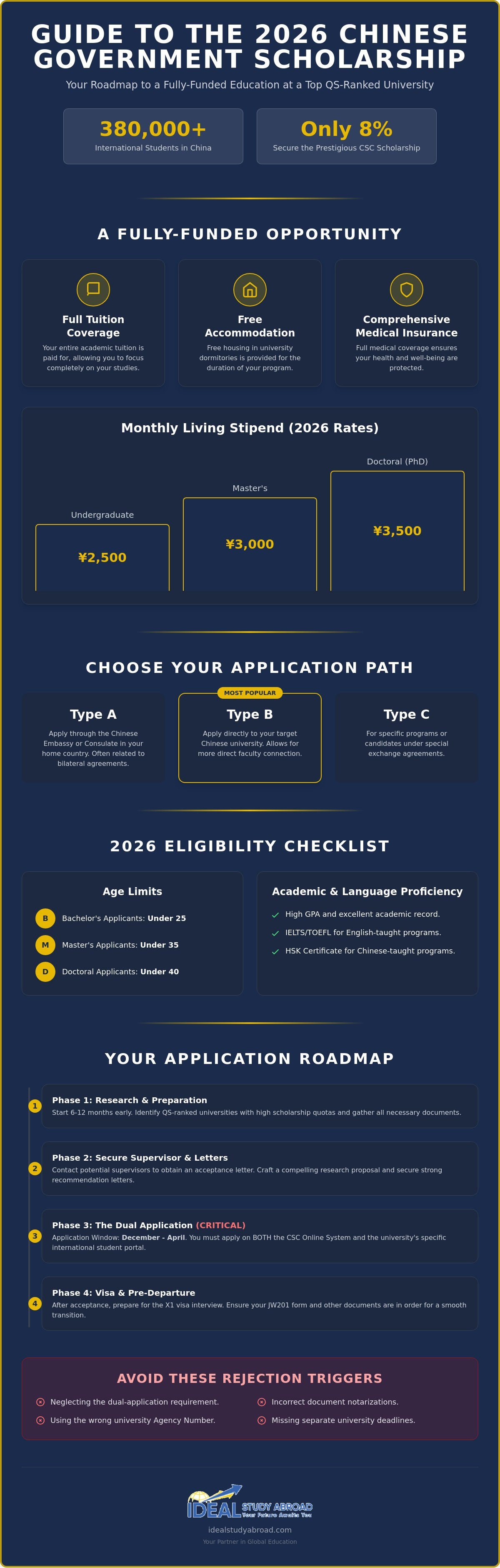
For the 2026 academic year, a full scholarship covers your tuition fees and provides free on-campus accommodation. You'll also receive a monthly living stipend to manage your daily expenses. Current verified rates for 2026 include CNY 2,500 for undergraduates, CNY 3,000 for Master's students, and CNY 3,500 for Doctoral candidates. This financial security allows you to focus entirely on your research or studies at a top-tier institution. Partial scholarships are also available, which may cover only tuition or accommodation, offering flexibility for different financial needs.
China is rapidly becoming a top destination for students from the UAE and beyond. Statistics from early 2026 show a 71.4% year-on-year increase in international student applications, reflecting the growing prestige of Chinese degrees. We prioritize placements in universities with high QS World University Rankings. These institutions offer superior research facilities and carry significant weight on your CV. When you target a QS-ranked school, you aren't just getting a degree; you're gaining a competitive edge in the global job market.
The Different Categories: Type A, Type B, and Type C
The application route you choose defines your journey. Type A applications are processed through the Chinese Embassy or Consulates in your home country, often following bilateral agreements. Type B is the most popular route, where you apply directly to your chosen Chinese university. This allows for a more personalized connection with your faculty. Type C is reserved for specialized programs and specific exchange agreements between international organizations and the Chinese government.
Who is Eligible? Requirements for 2026 Applicants
Meeting the eligibility criteria is the first step toward a successful placement. For the 2026 cycle, age limits are strictly enforced: Bachelor’s candidates must be under 25, Master’s applicants under 35, and PhD candidates under 40. Beyond age, a high GPA is essential to stand out in an increasingly competitive pool. Language proficiency is another critical pillar. While many programs are English-taught and require IELTS or TOEFL scores, Chinese-taught programs will require HSK certification. We help you navigate these requirements to ensure your application meets every institutional standard.
Step-by-Step Application Guide for the 2026 Academic Year
Securing a fully funded placement requires more than just academic merit; it demands a disciplined approach to a complex administrative timeline. You should begin your preparation at least 6 to 12 months before the December to April application window. Early preparation allows you to gather necessary documents and contact potential supervisors without the pressure of looming deadlines. Understanding how to get csc scholarship in china involves mastering the official CSC Online Application System, where you'll submit your digital dossier. A critical technical detail is the Agency Number, a specific five-digit code assigned to each university or embassy. Entering the wrong code can redirect your application to the wrong office, so verify this number twice before hitting submit.
One of the most common mistakes applicants make is neglecting the dual-application requirement. You must complete your profile on the CSC portal, but you often need to apply separately through the specific university's own international student portal. For example, the application process for U.S. students highlights how specific embassy deadlines can differ from university-specific cutoffs. Missing either of these deadlines usually results in an automatic rejection, regardless of your qualifications.
Phase 1: Research and University Selection
Your choice of institution dictates your success rate. Focus on universities that align with your research interests but also have high scholarship quotas for international students. We specialize in identifying these high-probability placements at top QS-ranked institutions. If you feel uncertain about which school matches your profile, consulting with an expert at Ideal Study Abroad can provide the clarity you need to move forward with confidence.
Phase 2: Document Preparation and Authentication
Documentation is where many high-potential candidates stumble. Notarization of your transcripts and degrees is a non-negotiable requirement. This means your local notary or the Chinese embassy must verify your academic records before they are uploaded. You'll also need the Foreigner Physical Examination Form, which is only valid for six months. Schedule this check-up carefully so it remains valid through the final selection phase in July or August. Finally, ensure you have a clean criminal record check from your local authorities. These documents form the foundation of your professional persona in the eyes of the admissions committee.
Crafting a Winning Application: The "Ideal" Strategy
A generic application is often a rejected application. To stand out among thousands of global applicants, you must shift your focus from simply "applying" to strategically positioning your academic narrative. The secret to how to get csc scholarship in china often lies in the documents that breathe life into your cold transcripts. Your application must demonstrate a clear vision that aligns your personal growth with the institutional goals of your chosen university. We view this process as a high-stakes professional pitch where your research potential serves as your primary currency.
Your recommendation letters act as external validation of your character and intellect. For the 2026 cycle, you must secure two letters from professors or associate professors. Letters from junior lecturers or employers generally carry less weight in the eyes of the CSC selection committee. These documents should not just praise your grades; they need to highlight your specific research skills, leadership qualities, and adaptability. Aligning these endorsements with your personal statement creates a cohesive, powerful profile that commands attention.
Writing a High-Impact Study Plan
Your Study Plan or Research Proposal is the most critical document in your dossier. For graduate applicants, this document typically requires a minimum of 800 words and must be meticulously structured. Avoid vague generalities. Instead, define specific research questions and explain your methodology. You must clearly demonstrate how your study benefits both China’s academic landscape and your home country’s development. This mutual benefit is a key priority for the China Scholarship Council. Ensure your formatting follows professional standards, using clear headings and a logical flow to prove you are ready for high-level academic work.
Contacting Professors for Acceptance Letters
Securing a "Provisional Acceptance Letter" from a Chinese supervisor is the single most effective way to boost your Type B application chances. Start by exploring faculty directories on the official websites of top QS-ranked universities. When you find a professor whose research matches yours, craft a concise, professional introductory email. Attach your CV and a brief summary of your research interests. Do not send mass emails; personalize every message to show you have actually read their recent publications. An acceptance letter tells the admissions office that a faculty member is already committed to mentoring you, which significantly reduces the perceived risk of your admission.
This proactive approach transforms you from a faceless applicant into a future colleague. By establishing these connections early, typically between November and February, you bypass the uncertainty that many other candidates face. We emphasize this mentorship-first strategy because it consistently produces the highest success rates for our clients seeking fully funded placements.
Common Pitfalls and How to Avoid Rejection
Securing a fully funded spot is a high-stakes endeavor where minor administrative oversights often lead to immediate disqualification. Even with a stellar GPA, failing to understand how to get csc scholarship in china through a coordinated dual-application process can end your journey before it starts. Many applicants complete the CSC portal but forget that most top-tier universities require a separate application on their own institutional platform. If you miss either deadline, your file remains incomplete. Additionally, targeting only over-saturated, world-famous universities without a backup strategy is a common tactical error. With application numbers rising by 71.4% in early 2026, diversification is your best defense against rejection.
Plagiarism is the quickest path to a permanent ban. The CSC utilizes advanced detection software to scan study plans and research proposals. If your content is flagged as unoriginal, you lose any future chance of receiving government funding. We always tell our clients that a personalized, slightly less polished plan is infinitely better than a "perfect" template found online. Authenticity demonstrates the critical thinking skills that Chinese admissions committees value most. You don't want to risk a lifetime of opportunity for the sake of a shortcut.
Administrative Errors That Cost Scholarships
- Agency Number mistakes: A single wrong digit redirects your entire application to the wrong authority, making it impossible for your chosen university to retrieve your file.
- Document naming conventions: The CSC portal is a bureaucratic system; if you don't name your files according to specific university-level requirements, they may be overlooked during the initial screening.
- Incomplete Physical Exams: Always ensure your Foreigner Physical Examination Form is fully signed and stamped by a physician. Incomplete medical records or outdated notarizations are top reasons for technical rejection.
Overcoming the Language Barrier
Language readiness is often misunderstood. Some students mistakenly apply for Chinese-taught programs without the required HSK level. In reality, most competitive programs require HSK 4 or 5 for entry. While English-taught options exist, the reality of these programs often involves navigating a bilingual environment. At Ideal Study Abroad, we evaluate your language readiness to ensure you apply for programs that match your actual proficiency. If you want to ensure your application is error-free and strategically sound, secure our professional admission assistance to safeguard your future academic success.
Final Steps: Visa Success and Pre-Departure Readiness
Securing your admission notice and scholarship award is a significant personal evolution, but your journey isn't complete until you've navigated the final administrative hurdle: the Chinese student visa. The most critical document you'll receive is the JW201 form. This specific document is reserved for government scholarship recipients and acts as the legal foundation for your X1 visa application. Unlike the JW202 form used by self-funded students, the JW201 confirms your fully funded status to the consulate. You must apply for an X1 visa if your program exceeds 180 days, and you'll need to convert this into a residence permit within 30 days of landing in China, which typically carries a fee of CNY 400.
Mastering how to get csc scholarship in china involves preparing for the logistical realities that follow the award letter. We don't just help you win the placement; we ensure you're ready for the transition. Our pre-departure briefings cover everything from mandatory medical insurance, which is CNY 800 per year for scholarship students, to cultural integration and packing essentials. This structured support helps to demystify the daunting final stages of moving abroad, positioning you for success from the moment you step off the plane.
Mastering the Visa Interview
The visa interview is your opportunity to prove that your academic intentions are genuine. For students applying from hubs like the UAE, consulate officers often ask about your specific research goals and why you chose China over other international destinations. You'll need to clearly link your scholarship success to your long-term career evolution. We provide professional visa interview preparation to help you practice these responses. Being able to articulate the value of your chosen QS-ranked institution demonstrates the leadership and maturity that officers look for during the brief encounter.
Your Future in China Starts Here
A degree from a top-tier Chinese institution is a life-altering milestone that opens doors across the globe. As an experienced global mentor, we remain a dedicated partner throughout your entire first semester. We provide ongoing guidance to help you settle into campus life and manage the administrative requirements of your new environment. Don't leave your international ambitions to chance. Take the first step toward your 2026 academic goals by booking a consultation for your Bachelor, Master, or PhD admission. Your future in one of the world's most dynamic economies is within reach, and we're here to guide you every step of the way.
Begin Your International Academic Evolution
Securing a fully funded placement at a top institution is a transformative milestone that demands more than just academic excellence. You've learned that success hinges on a proactive strategy, from identifying high-quota universities to securing provisional acceptance letters from respected faculty. Mastering how to get csc scholarship in china requires balancing these strategic documents with a disciplined approach to administrative deadlines and visa requirements. By aligning your research goals with China’s institutional priorities, you position yourself as a future global leader.
We're here to simplify this complex journey. With decades of expertise, we provide specialized medical school consultancy and expert guidance for top QS world-ranking universities. Our team ensures your transition is seamless through comprehensive visa interview preparation and detailed pre-departure briefings. Don't let the bureaucratic hurdles stand in the way of your ambitions. Start your journey to a fully funded degree in China with Ideal Study Abroad today. Your path to a prestigious international degree is clear, and we're ready to help you take that first confident step toward 2026.
Frequently Asked Questions
How much is the monthly stipend for the CSC scholarship in 2026?
The monthly living stipend for the 2026 academic year is CNY 2,500 for undergraduate students, CNY 3,000 for Master's candidates, and CNY 3,500 for Doctoral students. This allowance is provided in addition to your covered tuition fees and free on-campus accommodation. These verified rates ensure you can focus entirely on your academic research and personal evolution without the stress of daily financial burdens.
Is the IELTS or TOEFL mandatory for the Chinese Government Scholarship?
IELTS or TOEFL scores are generally mandatory if you're applying for an English-taught program, unless your previous degree was conducted entirely in English. While some institutions may accept an English Proficiency Certificate, a high score in a standardized test significantly boosts your profile. Mastering how to get csc scholarship in china involves presenting a dossier that leaves no doubt about your ability to succeed in a high-stakes academic environment.
Can I apply for the CSC scholarship without an acceptance letter?
You can apply without an acceptance letter, but your chances of securing a Type B scholarship are much lower. A supervisor acceptance letter serves as a powerful endorsement, proving that a faculty member is already committed to your mentorship. We encourage all our clients to reach out to professors early in the cycle to secure this vital document and distinguish themselves from the competitive global applicant pool.
What is the difference between Type A and Type B CSC applications?
Type A applications are processed through the Chinese Embassy or Consulate in your home country, while Type B applications are submitted directly to your target Chinese university. Type A often follows bilateral government agreements, whereas Type B is the preferred route for students who have a specific QS-ranked institution in mind. Choosing the right category is a critical strategic decision that affects your Agency Number and overall application timeline.
Can I work in China while studying on a CSC scholarship?
Working while studying is strictly regulated; you must obtain official permission from both your university and the local exit-entry administration for part-time employment. Most scholarship recipients find that their monthly stipend covers their essential needs, allowing them to prioritize their studies. It's important to remember that your scholarship is subject to an annual review, so maintaining your academic performance is always the primary requirement.
When will the CSC scholarship results for 2026 be announced?
Official results for the 2026 cycle are typically announced between July and August. After the university conducts its initial screening, the China Scholarship Council performs a final review before issuing your admission notice and the JW201 visa form. We stay in close contact with our students during this period, helping them prepare for their visa interviews and final departure logistics as soon as the results are released.
Is it possible to study Medicine in China with a full scholarship?
Yes, you can study Medicine, including MBBS and specialized postgraduate programs, with a full Chinese Government Scholarship. China's medical universities are world-renowned for their clinical facilities and research output. We specialize in medical school consultancy, helping students navigate the specific HSK requirements and academic prerequisites needed to win a fully funded spot in these highly competitive professional niches.
What are the HSK requirements for a Chinese-taught degree?
Most Chinese-taught degree programs require an HSK 4 or HSK 5 certificate to prove your language proficiency. If you haven't yet reached this level, many CSC scholarships include one year of preparatory Chinese language training before you start your actual degree. This foundational year is a fantastic opportunity to immerse yourself in the culture and ensure you're fully prepared for the rigors of university-level study in Chinese.