
The most strategic path to a European healthcare career in 2026 doesn't pass through London or Paris; it begins in Tirana. If you're looking to study nursing in albania for international students, you've likely realized that traditional Western routes are becoming increasingly inaccessible. You're probably tired of facing tuition fees that exceed AED 100,000 per year or strict IELTS requirements that don't reflect your actual clinical potential. It's exhausting to navigate complex visa systems that often feel like an intentional barrier to your medical ambitions.
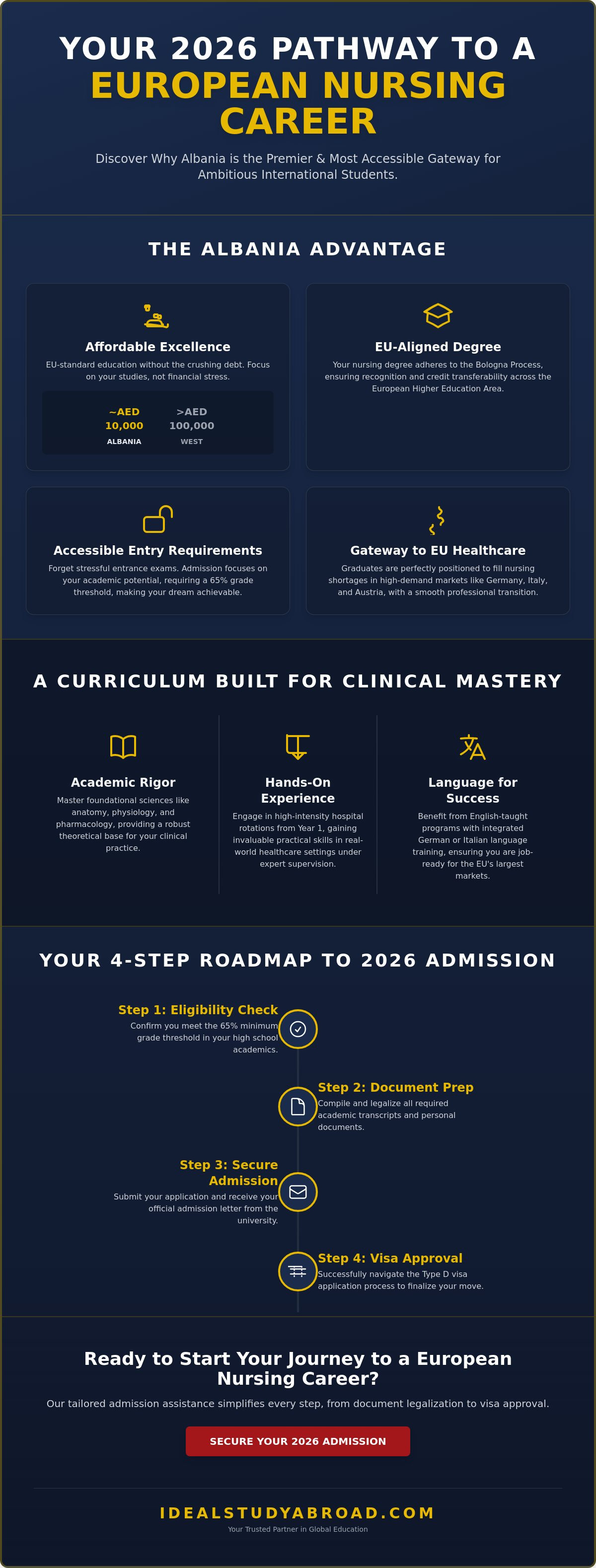
We're here to show you a more accessible and professional way forward. You'll discover how Albania serves as a specialized training ground that offers EU-aligned education with tuition starting near AED 10,000 per year. This guide provides everything you need to know about securing your 2026 admission, from meeting the 65% grade threshold to mastering the Type D visa application. We'll explore how this Mediterranean destination provides a high-quality, affordable gateway to a lifelong nursing career across the continent.
Key Takeaways
- Learn how Albania's alignment with the Bologna Process ensures your nursing degree meets rigorous European academic and professional standards.
- Discover why the decision to study nursing in albania for international students provides a strategic and accessible entry point into the European healthcare sector.
- Explore the curriculum structure of a Bachelor of Science in Nursing, focusing on the high-value clinical rotations and hands-on hospital experience required for global practice.
- Master the 2026 application roadmap, including the essential steps for document legalization and securing your official university admission letter.
- Identify how tailored undergraduate admission assistance can simplify complex bureaucratic hurdles and align your academic profile with the right institution.
Why International Students are Choosing Albania for Nursing in 2026
Albania's emergence as a premier healthcare education hub is a calculated response to the global nursing shortage. By choosing to study nursing in albania for international students, you're entering a system that has modernized rapidly to meet 2026 global standards. The Albanian education system has fully embraced the Bologna Process; this ensures your credits are transferable and your degree carries significant weight across the European Higher Education Area. This strategic alignment means your training is technically equivalent to programs found in much more expensive Western European nations.
The "Accessibility Advantage" is another primary driver for this shift. Many international aspirants find themselves blocked by high-stakes entrance exams or impossible language requirements in the UK or Germany. Albanian universities prioritize your existing academic record and your genuine potential for clinical excellence. This approach allows dedicated students to begin their medical journey immediately rather than spending years in preparatory limbo. You'll also benefit from a culture of deep-rooted hospitality. Local communities are exceptionally welcoming to international student populations, which helps you build a supportive social and professional network from day one.
The Economic Logic: Tuition and Living Costs
Comparing the costs of education reveals a stark contrast between Albania and traditional Western routes. While a nursing degree in the United Kingdom or North America can easily exceed 150,000 AED in annual tuition alone, Albania offers a world-class curriculum for a fraction of that investment. This financial sustainability allows you to focus on your clinical skills without the crushing weight of long-term student debt. Daily expenses are equally manageable; students typically find that housing, utilities, and groceries cost between 1,200 AED and 1,800 AED per month. This affordability makes it possible for students from diverse economic backgrounds to maintain a high quality of life while pursuing a high-stakes medical degree.
A Strategic Gateway to the European Labor Market
The 2026 European healthcare market is facing an unprecedented deficit of qualified nurses. Graduates from Albanian institutions are uniquely positioned to fill these gaps in countries like Germany, Italy, and Austria. Because the curriculum is designed to meet EU standards, the transition from student to professional is remarkably smooth. Many students find that the hands-on clinical experience gained in Albanian hospitals makes them highly competitive candidates for residency and employment across the continent. Albania functions as a specialized academic bridge that connects global talent to the high-demand healthcare sectors of the European Union.
The Nursing Curriculum: Academic Excellence and Global Standards
The Bachelor of Science in Nursing (BSN) in Albania is structured for students who prioritize clinical competency over abstract theory. When you choose to study nursing in albania for international students, you're committing to a three-year intensive program that balances foundational medical sciences with high-intensity practical training. You'll master anatomy, physiology, and pharmacology, but the real value lies in how these subjects are applied in a clinical setting from the very first year.
Hospital rotations are the heartbeat of the Albanian nursing curriculum. Students work under the direct supervision of seasoned medical professionals in both public and private healthcare facilities. These placements are closely monitored by the Albanian Ministry of Health and Social Protection, which ensures that every hour you spend in a ward contributes directly to your professional development. This hands-on approach is exactly what prepares you for the high-pressure environments of modern European hospitals.
Language proficiency is often a concern for international applicants, yet Albanian universities have turned this into a vocational advantage. While many programs are taught in English to maintain global standards, they also integrate German or Italian language training into the curriculum. This dual-language focus is a deliberate move to ensure graduates are ready for immediate employment in the EU's largest healthcare markets. If you're feeling overwhelmed by the choice of institutions, seeking specialized undergraduate admission assistance can help you identify which program best aligns with your long-term career destination.
Accreditation and the Bologna Process
Your degree's global value depends entirely on its recognition. Albanian nursing programs utilize the European Credit Transfer and Accumulation System (ECTS), making your credits transferable across 48 countries. We ensure that your chosen university is recognized by the relevant national authorities and aligned with the World Directory of Medical Schools standards. This accreditation is your guarantee that your hard work will be respected by licensing boards worldwide.
Modern Facilities and Technology in 2026
By 2026, Albanian medical universities have significantly upgraded their infrastructure to include high-fidelity simulation labs. You won't just learn from a screen; you'll use advanced medical tech and diagnostic tools to simulate real-world emergencies. The curriculum now also prioritizes digital health and informatics. You'll learn to navigate the electronic health records and telehealth systems that are now standard in the European labor market, giving you a distinct edge over candidates from less tech-integrated programs.
Choosing Your Destination: Albania vs. Romania and Bulgaria
Selecting the right country for your medical education requires a careful balance between academic rigor and logistical feasibility. While the Balkans and Eastern Europe offer several affordable hubs, the decision to study nursing in albania for international students is often driven by the country's unique accessibility. Romania and Bulgaria have long been established destinations, but their nursing programs have become increasingly competitive, often requiring rigorous entrance examinations or high-stakes interviews that can delay your career by a year or more. Albania, by contrast, offers a more streamlined entry process that prioritizes your existing academic foundations without compromising on quality.
Language support is another critical differentiator. While you might consider the option to study medicine in romania for its historical prestige, Albania has modernized its English-medium support specifically for the 2026 labor market. Universities here don't just teach in English; they integrate vocational language training to ensure you meet EU standards for nursing qualifications. This preparation is vital if you intend to practice in major European healthcare systems where technical fluency is a mandatory requirement for licensure.
Academic vs. Practical Focus
Albanian nursing programs stand out by prioritizing clinical hours over traditional classroom lectures. While regional neighbors may lean heavily into theoretical research, the Albanian model is closely aligned with the German healthcare system. This means you spend more time in simulation labs and hospital wards, gaining the hands-on experience that modern employers demand. From a return-on-investment perspective, Albania's lower living costs, often ranging between 1,200 AED and 1,800 AED per month, allow you to complete your degree with significantly less financial strain than in Sofia or Bucharest.
Consultancy Insight: The Ideal Study Abroad Perspective
We leverage over two decades of industry tenure to match your specific academic profile with the right geographic destination. Our specialized mbbs abroad consultancy services extend far beyond general medicine; we provide dedicated guidance for high-stakes nursing and physiotherapy tracks. We understand that your choice of country is a life-altering milestone. By evaluating your long-term career goals, we help you determine if the clinical focus of Albania or the research-heavy environment of its neighbors better serves your eventual success in the global healthcare sector.
The Application Roadmap: From Eligibility to Visa Approval
The transition from selecting a university to actually landing in Tirana requires a meticulous administrative strategy. If you want to study nursing in albania for international students, you must follow a rigid sequence to ensure your application isn't stalled by bureaucratic errors. We've simplified this journey into five actionable stages designed to move you from your current location to your first clinical lecture in 2026.
- Step 1: Document Preparation: Gather your high school transcripts and diplomas. These must be legalized and translated into Albanian to begin the formal evaluation process.
- Step 2: University Admission: Submit your profile to your chosen institution. Once the university verifies your academic standing, they'll issue an official admission letter, which is the primary document needed for your visa.
- Step 3: Visa Application: Apply online for the Type D (Long-stay) student visa. This process requires proof of your educational intent and your ability to sustain yourself during your stay.
- Step 4: Interview Readiness: Attend your consular appointment with confidence. Utilizing professional visa interview preparation is the most effective way to articulate your career goals to immigration officials.
- Step 5: Relocation Logistics: Finalize your travel and housing arrangements. Our comprehensive pre-departure briefing ensures you're fully prepared for the cultural and logistical shift of living in the Balkans.
Success in this process depends on timing and accuracy. If you're ready to begin your journey, our team provides the expert undergraduate admission assistance required to navigate these steps without delay.
Eligibility Criteria for International Students
To qualify for a nursing seat in 2026, you generally need a minimum score of 65% in your 12th-grade examinations, with a strong focus on Biology, Chemistry, and Physics. Albania's Ministry of Education requires a specific equivalency process known as "Nostrifikimi." This procedure verifies that your international schooling meets local standards. While most universities are flexible regarding gap years, you should be prepared to explain any significant breaks in your education with a clear professional or personal rationale.
Overcoming the Visa Hurdle
Visa rejections often stem from incomplete financial documentation or a lack of clarity regarding post-study intentions. You must provide proof of financial means, typically showing access to at least 1,200 AED to 1,800 AED for monthly living expenses, alongside valid travel health insurance. Engaging in professional visa coaching provides the strategic edge needed to navigate these high-stakes consular interactions successfully. We help you present a cohesive narrative that aligns your Albanian education with your long-term aspirations in the European healthcare sector.
Navigating Your Nursing Journey with Ideal Study Abroad
Choosing to study nursing in albania for international students is a significant personal evolution and a life-altering milestone. At Ideal Study Abroad, we don't just view your application as a set of documents; we see it as the foundation of your future healthcare career. With over 20 years of industry tenure, our team operates as an Experienced Global Mentor, providing the seasoned wisdom and reliability you need to navigate high-stakes international transitions. We're committed to your success far beyond the initial admission letter, acting as a dedicated partner from your first inquiry until you're settled in your new student home.
Our end-to-end support system is designed to provide clarity and momentum at every stage of the process. We simplify complex bureaucratic hurdles into manageable, sequential steps, ensuring you never feel overwhelmed by the administrative requirements of the Albanian Ministry of Education. By leveraging our multi-regional identity, we bridge the gap between your current academic profile and the institutional standards of top Albanian universities. Benefit from our comprehensive service suite, which includes:
- Personalized university selection based on your specific 2026 career goals
- Expert undergraduate admission assistance to secure your placement quickly
- Meticulous document evaluation to meet the "Nostrifikimi" equivalency standards
- Dedicated support for housing and local registration once you arrive in Tirana
Expert Guidance for Medical and Healthcare Placements
Specialized consultancy is essential when pursuing high-stakes healthcare degrees. Unlike generalist agencies, we focus on professional niches where the margin for error is zero. Our deep connections with reputable universities in Albania ensure that your BSN degree aligns with global practice standards. We provide ongoing support that extends into your career transition, helping you understand how your Albanian credits will be recognized by licensing boards across Europe. This long-term focus is a central pillar of our commitment to your eventual success as a registered nurse.
Start Your Global Nursing Career Today
Secure your future by booking your first consultation with our expert team. During your initial assessment, we'll evaluate your academic transcripts, discuss your clinical interests, and provide a clear roadmap for your 2026 enrollment. This session is designed to instill confidence and provide a practical overview of the journey ahead. Don't let complex visa procedures or high tuition fees in other regions delay your ambitions. Pursue your goals with a trusted global mentor by your side. Contact Ideal Study Abroad today and take the first step toward a rewarding nursing career in the heart of the Mediterranean.
Secure Your Seat in the 2026 Nursing Class
Choosing to study nursing in albania for international students is a strategic investment in a high-growth healthcare career. You've discovered how Albania's alignment with the Bologna Process ensures your degree carries weight across the European Union, while the manageable cost of living keeps your medical ambitions sustainable. By prioritizing hands-on clinical rotations and modern simulation labs, these programs prepare you for the technical demands of the global labor market. This Mediterranean gateway offers a professional path that balances academic rigor with practical accessibility.
Success in international admissions requires more than just good grades; it demands the seasoned wisdom of a guide who understands the high-stakes nature of medical licensing. We leverage over 20 years of experience in medical admissions to provide specialized healthcare consultancy for Europe and Asia. Our team delivers expert visa interview preparation with high success rates, ensuring you clear the final administrative hurdles with confidence. Start your journey toward a European nursing career with Ideal Study Abroad today! We're ready to help you transform your professional vision into a reality. Your future in global healthcare is within reach, and we're here to ensure you arrive prepared.
Frequently Asked Questions
Is nursing in Albania taught in English?
Yes, many leading universities in Tirana offer nursing programs entirely in English to accommodate global applicants. These programs are specifically designed to ensure that you can transition into international healthcare systems without language barriers. Beyond English, many institutions integrate vocational training in German or Italian to increase your employability in the EU. This dual-language approach ensures you're ready for high-stakes clinical environments immediately after your graduation.
Can I work in Germany or Italy after studying nursing in Albania?
Absolutely; an Albanian nursing degree is a recognized gateway to the European labor market. Because Albania follows the Bologna Process, your ECTS credits are transferable to countries like Germany, Italy, and Austria. Many graduates find that the clinical focus of their training makes them highly competitive candidates for healthcare roles across the continent. We provide specialized guidance to help you understand the specific licensure requirements for your target country.
Do I need IELTS or TOEFL to study nursing in Albania?
Most Albanian universities don't require a formal IELTS or TOEFL score for admission. This is a major advantage for students who have completed their previous education in English or can demonstrate proficiency through other means. Instead of standardized testing, institutions may conduct their own assessment or accept a letter of proficiency from your previous school. This makes the decision to study nursing in albania for international students much more accessible.
What is the duration of a Bachelor of Nursing program in Albania?
A standard Bachelor of Science in Nursing (BSN) program in Albania typically lasts three academic years. This duration aligns with the 180 ECTS credit requirement used across the European Higher Education Area. During these three years, you'll balance theoretical coursework with extensive clinical rotations in both public and private hospitals. This condensed yet intensive structure allows you to enter the professional workforce faster than in many other regions.
Are Albanian nursing degrees recognized by the World Health Organization (WHO)?
Yes, nursing degrees from accredited Albanian institutions are recognized globally and listed in the World Directory of Medical Schools. This recognition ensures that your qualification is respected by the World Health Organization (WHO) and other international bodies. It's vital to choose a university that maintains these high-stakes accreditations to ensure your degree is valid for future postgraduate studies or professional registration in Europe, Asia, or North America.
How much does it cost to live in Albania as an international student?
Living costs in Albania are exceptionally affordable, typically ranging between 1,200 AED and 1,800 AED per month. This budget covers your student accommodation, utilities, groceries, and local transportation in cities like Tirana or Durrës. Compared to the high expenses in Western Europe or the UAE, this allows you to maintain a high quality of life while focusing on your medical studies. Financial sustainability is a primary reason students choose this destination.
Can I work part-time while studying nursing in Albania?
International students in Albania are generally permitted to work part-time for up to 20 hours per week. This allowance helps you gain local work experience and supplement your living expenses while you study nursing in albania for international students. Many students find roles in the service sector or healthcare-related internships that provide valuable professional exposure. However, we recommend prioritizing your clinical rotations and academic commitments during the intensive phases of your nursing program.
What are the main entry requirements for international students?
The primary entry requirements include a high school certificate with a strong focus on Biology, Chemistry, and Physics. Most universities look for a minimum average of 65% in your final secondary school examinations. You'll also need to complete the "Nostrifikimi" process, which is the official recognition of your foreign diploma by the Albanian Ministry of Education. Our team provides end-to-end support to ensure your documentation meets these specific institutional standards.